# Linux 7.3 will, barring surprises, be the 2026 LTS kernel: what Greg Kroah-Hartman said and who it affects
- **Published on:** 2026-11-23
- **Category:** News
- **Original page:** https://free-linux.com/articles/linux-7-3-next-lts-kernel
Greg Kroah-Hartman has told the kernel mailing list to count on 7.3 as the next long-term support kernel, not 7.4, which many took for granted. We explain why, review the current LTS kernels and their end dates, and check which kernel Debian, Ubuntu, Fedora and Alpine ship today.
---
Every year, one of the kernels Linus Torvalds releases becomes an **LTS** (*longterm*) kernel: instead of losing patches a few weeks later like the rest, it is maintained for at least two years. Many stable distributions, device makers and cloud providers build on it, so the choice is no small detail.
This year nearly everyone expected **Linux 7.4**, the last release of 2026, to be the one. But **Greg Kroah-Hartman**, who maintains the stable branches with Sasha Levin, has said otherwise on the kernel mailing list: count on **Linux 7.3** as the next LTS, unless something "really crazy" gets in the way.
It isn't a formal announcement yet. As of today, kernel.org still lists 7.3 as a stable branch, not in the LTS table. But coming from the person who decides, it's about as close to confirmation as you usually get ahead of time.
## What Greg Kroah-Hartman said
It all started with the **7.4-rc1** announcement on 1 November. Torvalds explained that it had been a huge merge window, almost 20,000 commits against the usual 15,000. He put it down mostly to the flood of fixes for bugs found with AI, but added a second possible cause: people assumed 7.4 would be the next LTS, which always makes a release grow.
Kroah-Hartman replied the next day. He said he had assumed 7.4 would come out in the first week of January, which is why he had planned for the LTS to be 7.3, the last release of the year. His scripts, however, now put 7.4 on **20 December**. He's sticking to the plan anyway:
> If people are trying to "force" stuff into 7.4 that's the best possible reason to NOT have it be the next LTS release as we have had this happen in the past and suffered greatly for it. So let's just count on 7.3.y to be the next LTS unless something really crazy comes up with it that would prevent that from happening.
## Why not 7.4
There are two parts to the explanation. The first is the calendar: Kroah-Hartman picks the LTS towards the end of the year, and he expected 7.3 to be the last release of 2026. The second runs deeper. When developers know which release will be the LTS, they tend to push immature code into it rather than wait another year, and that turns the long-term branch into the hardest one to maintain. Saying early that it won't be 7.4 removes the temptation.
If 7.4 lands on 20 December as planned, it will be the first time in years that the LTS isn't the last release of the year. Since 2020 it always has been:
| Year | LTS | Released | Next release |
|---|---|---|---|
| 2020 | 5.10 | 13 Dec 2020 | 5.11, 14 Feb 2021 |
| 2021 | 5.15 | 31 Oct 2021 | 5.16, 9 Jan 2022 |
| 2022 | 6.1 | 11 Dec 2022 | 6.2, 19 Feb 2023 |
| 2023 | 6.6 | 29 Oct 2023 | 6.7, 7 Jan 2024 |
| 2024 | 6.12 | 17 Nov 2024 | 6.13, 19 Jan 2025 |
| 2025 | 6.18 | 30 Nov 2025 | 6.19, 8 Feb 2026 |
| 2026 | **7.3** (planned) | 18 Oct 2026 | 7.4, expected 20 Dec 2026 |
## Current LTS kernels and when they expire
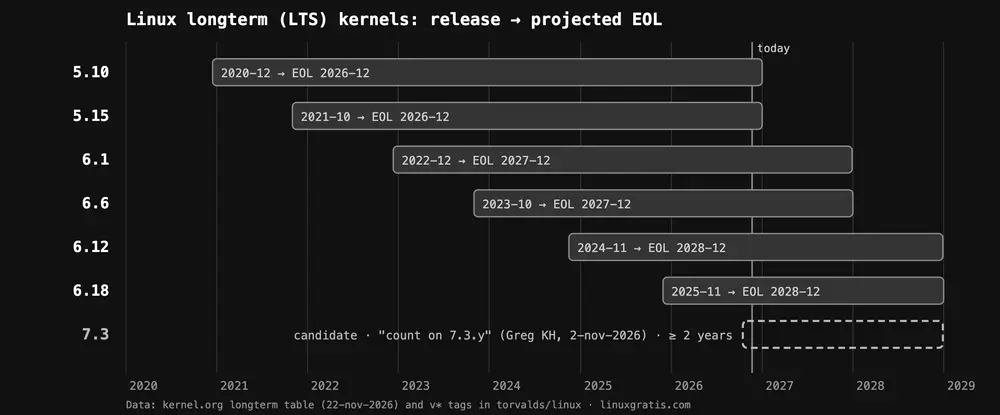
The six LTS kernels supported on kernel.org and 7.3, the 2026 candidate · Our own diagram with kernel.org data
There are six LTS kernels supported on kernel.org. The end dates are "projected", not final: a new LTS starts with two years of support and is extended if the industry commits resources to maintain it.
| Version | Released | Projected EOL | Latest release (22 Nov) |
|---|---|---|---|
| 6.18 | 30 Nov 2025 | December 2028 | 6.18.64 |
| 6.12 | 17 Nov 2024 | December 2028 | 6.12.118 |
| 6.6 | 29 Oct 2023 | December 2027 | 6.6.162 |
| 6.1 | 11 Dec 2022 | December 2027 | 6.1.192 |
| 5.15 | 31 Oct 2021 | **December 2026** | 5.15.225 |
| 5.10 | 13 Dec 2020 | **December 2026** | 5.10.274 |
Note the last two rows: **5.10 and 5.15 stop getting patches next month**. Anyone with machines or devices on those kernels, maintained straight from kernel.org, should be planning the move.
As for the 7.2 branch, it's already closed: kernel.org marked it end-of-life with 7.2.15 on 1 November. Normally 7.3 would meet the same fate a few weeks after 7.4 comes out. If it's confirmed as LTS, it will keep getting fixes until at least late 2028.
## Which distributions will notice
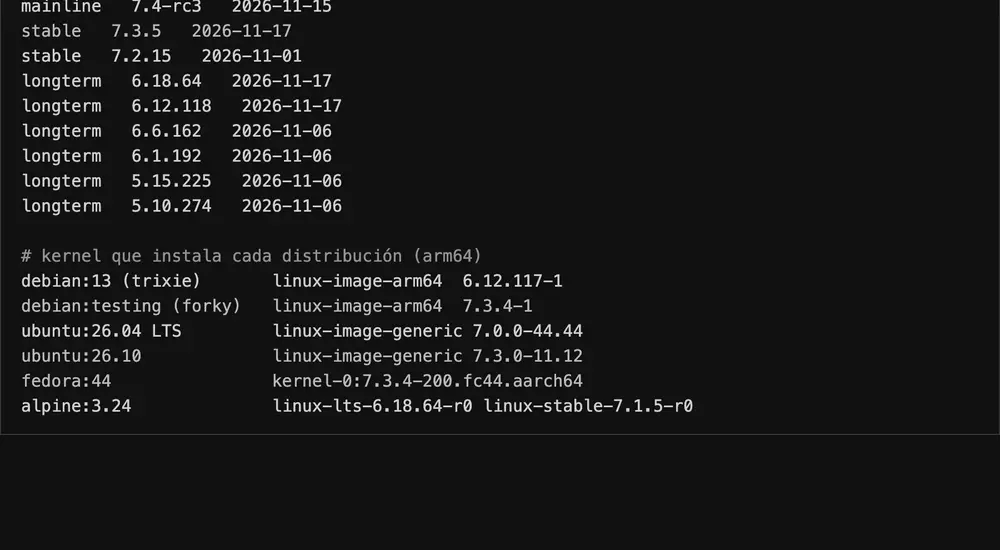
kernel.org's branches and the kernel each distribution installs today · Own screenshot
We checked in containers which kernel each distribution installs today:
| Distribution | Kernel it installs | What it tracks |
|---|---|---|
| Debian 13 (trixie) | 6.12.117 | The 2024 LTS |
| Debian testing (forky) | 7.3.4 | Already on 7.3 |
| Ubuntu 26.04 LTS | 7.0.0 | Canonical's own kernel |
| Ubuntu 26.10 | 7.3.0 | The current release |
| Fedora 44 | 7.3.4 | Always the latest stable |
| Alpine 3.24 | 6.18.64 (`linux-lts`) and 7.1.5 (`linux-stable`) | One LTS and one stable |
| Arch Linux | 7.3.5 (`linux`) and 6.18.64 (`linux-lts`) | Stable and LTS |
**Debian** is the clearest case. Debian 12 shipped with 6.1, the 2022 LTS, and Debian 13 with 6.12, the 2024 one: always an LTS kernel. Debian 14 (forky) has no freeze dates yet (the release team's page still says "TBA"), but its testing branch is already on 7.3, and 7.3.4 is also in `trixie-backports`. If 7.3 is confirmed as LTS, it's the natural candidate for forky.
**Ubuntu** doesn't follow kernel.org's LTS releases. Ubuntu 26.04 LTS uses 7.0, a version kernel.org doesn't maintain, and Canonical supports it itself. Ubuntu 26.10 already ships 7.3, and Canonical usually brings interim-release kernels to its LTS releases as HWE kernels.
**Fedora and Arch** always run the latest stable and are already on 7.3. For them the announcement changes nothing. Arch keeps a separate `linux-lts` package, still on 6.18 today, just like Alpine's `linux-lts`.
Beyond PCs, device makers depend on these kernels too. Android's common kernels, for example, are built from kernel.org releases and their LTS branches.
## What it means for you
If you use a distribution that tracks the latest stable (Fedora, Arch, openSUSE Tumbleweed), nothing: you'll keep moving to 7.4 and beyond as soon as they come out.
If you build your own kernel, or look after embedded systems or servers running a kernel.org kernel, the news does matter: you can start testing 7.3 knowing that, unless plans change, it will get patches for years. And if you're still on 5.10 or 5.15, you're already late.
On the flood of AI-found fixes that has swelled 7.4, we explained [why it lands mostly in the kernel's C code](/articles/linux-7-4-rust-c-ai-fixes), and on 7.3, [what it brings Asahi Linux on M3 Macs](/articles/asahi-linux-7-3-m3-thunderbolt-gpl).
## How we tested this
On 22 November, with Docker on an Apple Silicon Mac (hence the arm64 kernel packages). We read the state of each branch from kernel.org's `releases.json` with `curl` and `jq`, and asked each distribution's package manager which kernel it would install:
```sh
docker run --rm debian:13 bash -c 'apt-get -qq update; apt-get -qq install -y curl jq >/dev/null; \
curl -s https://www.kernel.org/releases.json | jq -r ".releases[] | \"\(.moniker)\t\(.version)\t\(.released.isodate)\""'
docker run --rm debian:testing bash -c 'apt-get -qq update; apt-cache policy linux-image-arm64'
docker run --rm ubuntu:26.10 bash -c 'apt-get -qq update; apt-cache policy linux-image-generic'
docker run --rm fedora:44 dnf -q repoquery --latest-limit 1 kernel
docker run --rm alpine:3.24 sh -c 'apk update -q; apk list linux-lts linux-stable'
```
There's no official Arch Linux image for arm64, so we took its versions from the archlinux.org package API. The release dates of each kernel version are those of their tags in Linus Torvalds' repository. When we finished we removed the containers.
**Sources:** [Re: Linus 7.4-rc1](https://lkml.iu.edu/hypermail/linux/kernel/2611.0/03360.html), Greg Kroah-Hartman's reply (2 Nov 2026, [on lore.kernel.org](https://lore.kernel.org/all/2026110241-yarn-tweak-084d@gregkh/)) and Linus Torvalds' [Linux 7.4-rc1 announcement](https://lkml.iu.edu/hypermail/linux/kernel/2611.0/00796.html) (1 Nov 2026); kernel.org's [longterm releases table](https://www.kernel.org/category/releases.html) and [releases.json](https://www.kernel.org/releases.json); [Linux repository tags](https://github.com/torvalds/linux/tags); the [linux-image-amd64 package in Debian](https://packages.debian.org/search?keywords=linux-image-amd64&searchon=names&exact=1&suite=all§ion=all) and the [forky freeze timeline](https://release.debian.org/forky/freeze_policy.html); Arch Linux's [linux](https://archlinux.org/packages/core/x86_64/linux/) and [linux-lts](https://archlinux.org/packages/core/x86_64/linux-lts/) packages; [Android common kernels](https://source.android.com/docs/core/architecture/kernel/android-common). Checked on 22 Nov 2026.