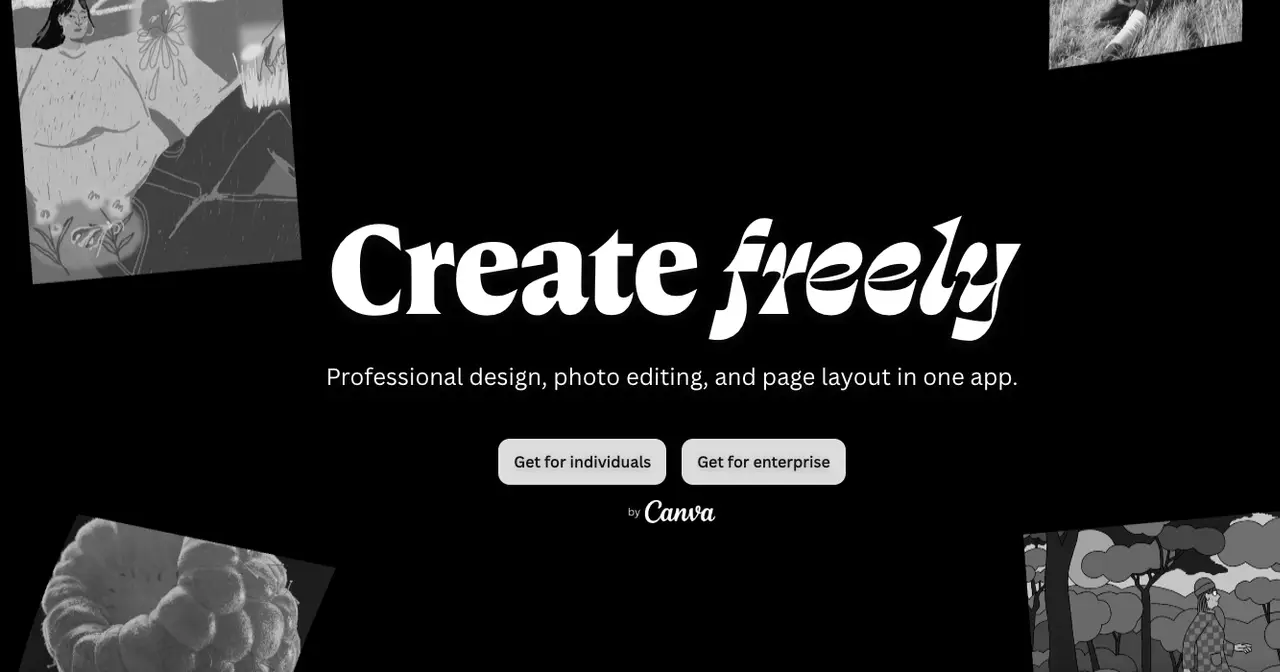
Affinity, the graphic design, photo editing and page layout suite that Canva has been giving away for a year, is getting a Linux version. The official Affinity account on X confirmed it on 2 November 2026, replying to two users who had asked: “Affinity is coming to Linux, it’s in active development, but we’ve got no ETA to spill just yet.”
It’s worth being precise about what this is. There’s no press release, no Canva blog post and no new page on affinity.studio: it’s a reply on X from the official account, written in a playful tone (“Take a deep breath, because we’re about to spill the tea”). The account’s own bio and the product site still list Mac, Windows and iPad. Still, it comes from the brand itself, not from an employee speaking personally or from a rumour, and it’s the first time Affinity has said publicly that a port exists and is being worked on.
From Serif to Canva, and from paid to free
Affinity was built by Serif, a Nottingham company founded in 1987 that launched Affinity Designer, Affinity Photo and Affinity Publisher as one-off-purchase alternatives to Illustrator, Photoshop and InDesign. Canva bought Serif in March 2024, along with a team of around 90 people, and published a set of pledges to users at the time, including keeping perpetual licences and free access for schools and nonprofits.
The big shift came on 30 October 2025, when Canva unveiled the new Affinity: a single app that folds the three old ones into three “studios” (Pixel, Vector and Layout) and is free for anyone with a Canva account. What costs money is the Canva AI features built into the app, which need a paid plan. Previously purchased V2 apps keep working but no longer get updates. The new app is available for macOS and Windows, with iPad announced as the next platform.
Going free is exactly what made the calls for a Linux version louder: a professional tool that costs nothing is attractive to plenty of people who no longer run Windows.
A long-standing request
The demand isn’t new. Affinity’s official forum has collected requests for a port for years, and the company’s last public word on Linux was a 2019 answer from a staff member in the forum FAQ that committed to nothing. In January 2025 a Change.org petition, #AffinityOnLinux, went up and has passed a thousand signatures. This week’s reply is the first that moves from “we won’t rule it out” to “we’re doing it”.
How people run Affinity on Linux today
Until there’s a native build, the route is Wine, and it isn’t always smooth. The Windows builds of Affinity lean on .NET and Direct2D components that stock Wine didn’t handle well, so the community has been filling the gaps:
- ElementalWarrior’s Wine fork (James McDonnell), hosted on WineHQ’s GitLab, with patches that get the installer and the app running. Many third-party scripts and guides build on it.
- Affinity Plugin Loader by noahc3, a runtime patch loader for Affinity V3 that ships WineFix, a plugin dedicated to fixing bugs that only show up under Wine.
- Several unofficial installers and packages on GitHub that automate all of the above, including at least one that ships it as an AppImage.
It works reasonably well for many people, with known trade-offs: signing in with a Canva account, GPU acceleration, UI scaling on HiDPI screens and updating to newer builds can all break. A native version should do away with most of that. It’s the same story Windows games went through before Proton, also built on Wine, made them playable at scale; we covered it in the history of Linux gaming.
It wouldn’t be the first commercial creative app on Linux
Linux already has a short but serious list of native commercial creative software. Blackmagic Design’s DaVinci Resolve offers a Linux build of its video editor and colour grading suite; Bitwig Studio is one of the few commercial digital audio workstations with an official Linux version; and in VFX and 3D, Houdini (SideFX), Maya (Autodesk) and Nuke (Foundry) have run on Linux for years because film studios use it. Graphic design and illustration, though, is still almost entirely the territory of free software such as GIMP, Inkscape, Krita and Scribus. Affinity would be the first top-tier commercial suite in that space to arrive.
What we don’t know
Anything beyond that one sentence on X is speculation for now:
- Date: none. “No ETA” means exactly that.
- Packaging: Canva hasn’t said whether it will use Flatpak, Snap, AppImage, .deb and .rpm packages or a mix, nor which distributions it will officially support.
- Technology: there’s no word on whether it’s a native port of the Affinity engine or something built on a compatibility layer.
- Features: it’s unclear whether all three parts of the app and Canva’s AI features will be there from day one.
If you want to get ready, the safe bet is the most widely used desktop distributions: Ubuntu and Fedora tend to be the first targets for any commercial software that comes to Linux, and Ubuntu Studio is already geared towards creative work with GIMP, Krita, Inkscape and friends. For now, though, the only certainty is that Canva has decided to do it.
Sources: @Affinity reply on X (2 Nov 2026); “Welcome to Canva, Affinity!” and “The Affinity and Canva Pledge” on the Canva newsroom; announcement of the new free Affinity; Accessing Affinity for free with a Canva account (Canva Help Center); #AffinityOnLinux petition; ElementalWarrior’s Wine fork; Affinity Plugin Loader and WineFix.