We have spent months covering how free software projects try to set rules for patches written with language models. This week brought two signs that the problem is no longer just about rules but about time: a veteran kernel developer has dropped part of his review work because he can’t keep up, and Git, which has so far settled its decisions by consensus, is getting ready to vote precisely on this topic.
Stoakes stops reviewing outside his own areas
Lorenzo Stoakes works at Arm and is one of the go-to names in Linux memory management. He maintains reverse mapping (rmap), memory mapping, its locking and madvise. He was also listed as a reviewer for other parts of the subsystem.
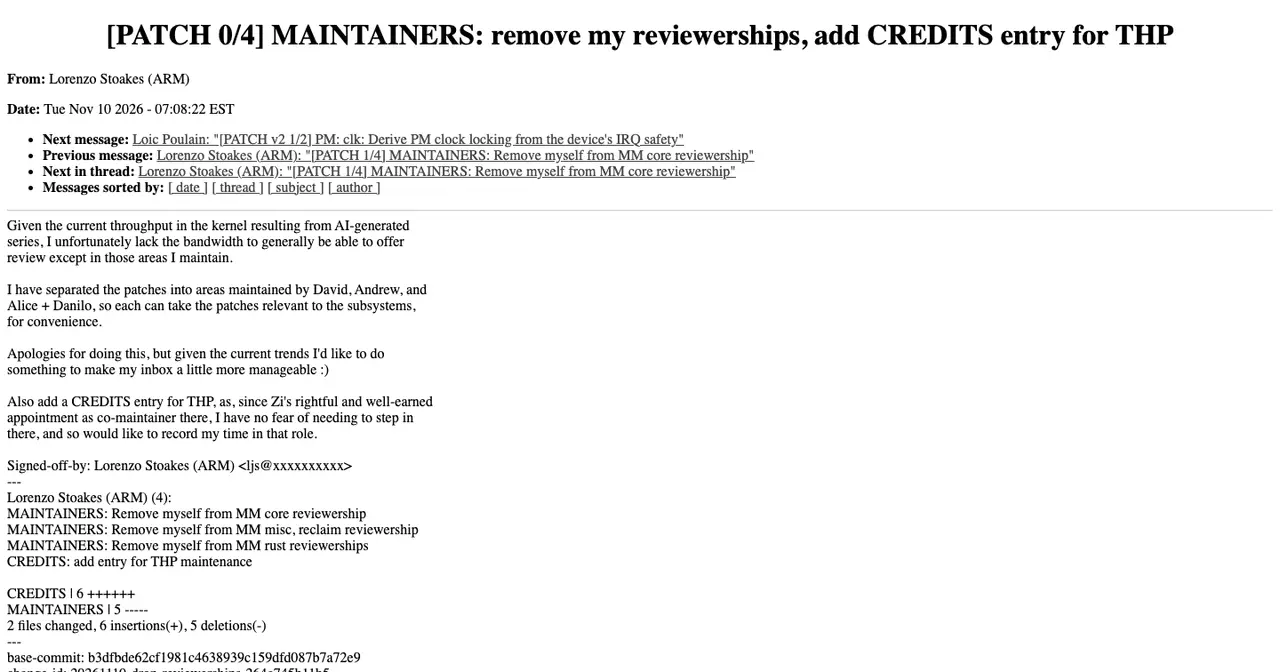
On 10 November he sent a four-patch series removing himself as a reviewer for MM core, MM misc, reclaim and the memory-related Rust areas. The reason, in the cover letter:
Given the current throughput in the kernel resulting from AI-generated series, I unfortunately lack the bandwidth to generally be able to offer review except in those areas I maintain.
Later in the thread, replying to Andrew Morton (who runs the memory management tree and jokingly asked whether a “Nacked-by”, the formal rejection of a patch, was allowed), Stoakes described how it got here:
Of course the AI wave has been horrible, and is getting significantly worse. At first it was once in a while that I’d see slop. Then it was at least once a week. Then every few days. Nowadays it’s pretty much half of what I see, if not more.
It shouldn’t be overstated. Stoakes keeps his maintainerships, says he will still dive in to review “when needed”, and calls it mostly “an administrative thing” to cut the noise in his inbox. He also mentions that KVM now takes a lot of his time. The fourth patch adds a CREDITS entry for his time as THP (transparent huge pages) co-maintainer, where Zi Yan has taken over. David Hildenbrand and other memory developers replied with their Acked-by. As of 11 November the changes are not yet in Linus’s tree.
He isn’t the only one lightening the load. A day earlier, Hildenbrand removed himself as a reclaim reviewer “to have a bit less noise in my inbox”, without mentioning AI. That same week, Dave Young stopped reviewing kdump for lack of time.
This ties in with what we covered recently: in October the kernel dropped the Assisted-by tag for patches made with an LLM’s help, because hardly anyone used it. We explained it in how Linux, Mesa, PostgreSQL and FreeRDP handled AI-made patches. The kernel’s workload shows in security too, as we saw yesterday with the flood of kernel CVEs.
Git gets ready to vote
In Git the debate has been stuck for longer. At the Contributor Summit in September people discussed how to accept AI-made contributions, without agreement. On 21 October Emily Shaffer (Google) sent a patch with an unusual proposal: not an AI policy, but a procedure to vote on one. Her reasoning: the topic is so contentious that she doesn’t expect the kind of consensus the project has used to settle almost everything so far.
The document, CommunityVoting.adoc, frames voting as a last resort in three phases:
- Proposals (about four weeks). Each is sent as a documentation patch and only makes the ballot if another voter seconds it with a
Seconded-by:line. - Voting (two weeks). By mail, on a specific version of each proposal. The counting method is still “TBD”.
- Implementation. The winning proposal is merged without delay, with a link to the thread and the result in the commit message.
Voters are those with a commit merged to the next branch or at least two code reviews. To stop anyone flooding the list with filler reviews to inflate their side’s electorate, only contributions made before the email opening the vote count.
The thread has been active for almost three weeks, mostly arguing over who gets to vote. Junio C Hamano, Git’s maintainer, prefers simple rules, such as requiring five commits rather than counting “topics” or reviews. Phillip Wood suggested limiting the vote to people who contributed in the last two years, and Patrick Steinhardt is fine with that as long as exclusions are transparent. Meanwhile, another contributor has proposed writing down how the project is governed today. There is no date yet for the vote on the AI policy.
Our take
Both cases show the same thing from different angles. Writing a patch keeps getting cheaper, but reviewing it costs as much as ever, and the bill falls on a few experienced people. When half of what arrives is low quality, reviewers end up narrowing what they look at, like Stoakes, or the project needs a clear rule that its usual consensus can’t produce, like Git. For Linux users nothing changes in the short term, but it’s worth watching: the kernel’s quality depends on those few people not burning out. Kernel versions and support dates are on our Linux page.
Sources: Lorenzo Stoakes’s series “MAINTAINERS: remove my reviewerships, add CREDITS entry for THP”, the first patch, the CREDITS patch and his reply to Andrew Morton (Indiana University LKML archive); David Hildenbrand’s reclaim patch; Linux MAINTAINERS file; Emily Shaffer’s proposal “Documentation: propose community voting process” and replies by Junio C Hamano and Patrick Steinhardt on the Git mailing list.