CVE-2026-98432 went public on 15 October as one of the hundreds of identifiers the kernel’s own CNA hands out, and it looked routine until the last week of the month. On 27 October a proof of concept turned it into unauthenticated, zero-click remote code execution as root against Linux servers with a Multipath TCP (MPTCP) listener. The kernel CNA scores it 9.8 (AV:N/AC:L/PR:N/UI:N), and Red Hat rates it Critical.
One thing needs saying up front: the bug is not in MPTCP. It lives in the IPv4 TCP code. MPTCP is simply the setup the exploit was demonstrated on, which is why turning it off narrows the exposure without removing it.
What MPTCP is
Multipath TCP (RFC 8684) extends TCP so a single connection can run over several paths at once, say Wi-Fi plus mobile data, or two NICs on a server. The application still sees one socket, while the kernel opens several TCP subflows underneath. Linux has shipped it since 5.6, and distribution kernels such as Debian’s and Fedora’s build it in (CONFIG_MPTCP=y).
According to the kernel documentation, net.mptcp.enabled defaults to 1, so any program can ask for an MPTCP socket. One detail widens the blast radius considerably: since Go 1.24, Go programs open their listening sockets with MPTCP by default on Linux. A Go HTTP server built with a recent toolchain may well be listening over MPTCP without anyone having asked for it.
Where the bug is
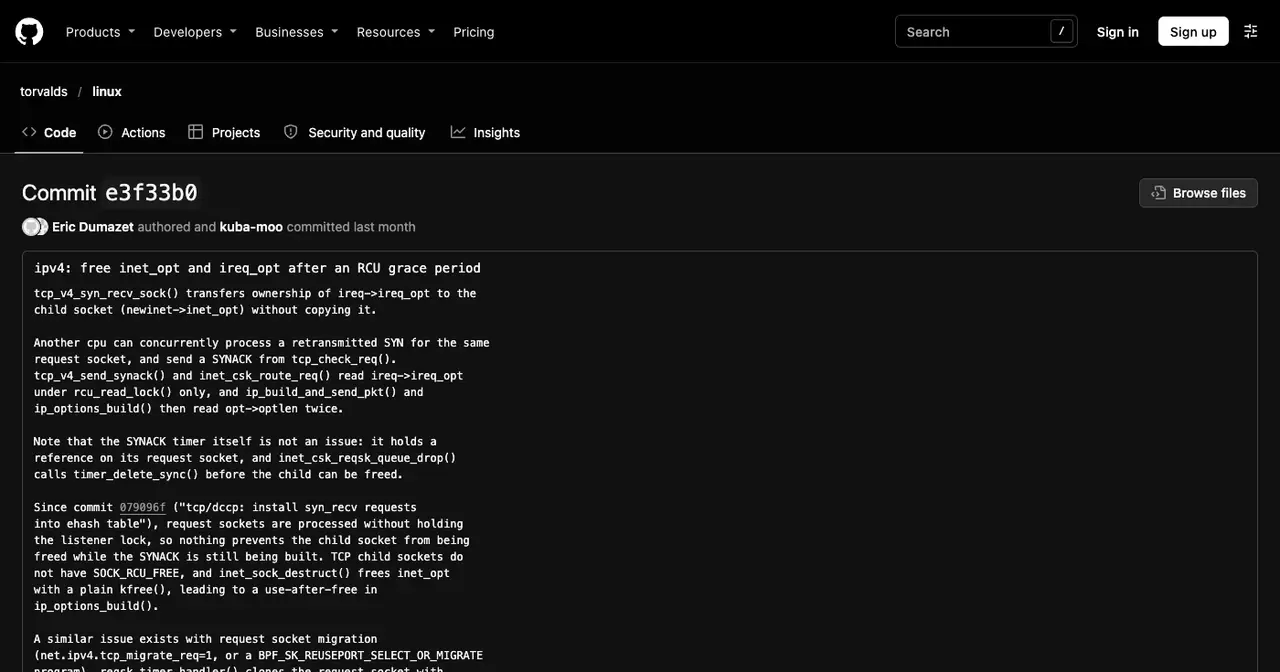
When a SYN arrives carrying IPv4 options (Record Route or Timestamp), the kernel stores them on the request socket. Once the handshake completes, tcp_v4_syn_recv_sock() hands those options to the child socket without copying them. If another CPU is processing a retransmitted SYN for the same connection at that moment, it builds a SYN-ACK while reading the options under rcu_read_lock(). But inet_sock_destruct() freed them with a plain kfree() rather than waiting for an RCU grace period, so if the child socket is torn down while the SYN-ACK is being built, ip_options_build() ends up working on freed memory.
The root cause goes back to commit 079096f103fa (“tcp/dccp: install syn_recv requests into ehash table”) from 2015, which stopped holding the listener lock while processing requests. A similar issue exists in request migration (net.ipv4.tcp_migrate_req=1). IPv6 avoids the first problem because it duplicates the options instead of transferring them.
The published exploit works in two stages. It first wins the race so that the kernel copies extra bytes into the SYN-ACK, leaking a pointer that defeats KASLR. It then reuses the same bug to overwrite a function pointer and chain existing kernel code into a root shell command. In the proof of concept, leaking the pointer took 48 minutes and reaching command execution five more. A lost race just fails the handshake, so an attacker can keep retrying, although the CVSS rationale notes that some values trigger skb_under_panic() and take the box down.
The bug was reported by Xinyang Ge, and the fix by Eric Dumazet swaps kfree() for kfree_rcu() in inet_sock_destruct() and tcp_v4_reqsk_destructor().
Affected and fixed versions
Every kernel since Linux 4.4 is affected. The fix landed in mainline for Linux 7.3-rc7, so the final 7.3 release already has it, and it has been backported to every maintained stable branch:
| Branch | Fixed in |
|---|---|
| 5.10 | 5.10.272 |
| 5.15 | 5.15.223 |
| 6.1 | 6.1.190 |
| 6.6 | 6.6.159 |
| 6.12 | 6.12.113 |
| 6.18 | 6.18.56 |
| 7.2 | 7.2.10 |
| mainline | 7.3 |
Distribution status as of 3 November:
- Debian: fixed in bookworm with
linux6.1.190-1 (DLA-4841-1) andlinux-6.126.12.113-1~deb12u1 (DLA-4850-1), and in trixie with 6.12.113-1 (DSA-6568-1). Forky and sid are fixed too. - Ubuntu: rated high priority. 22.04, 24.04, 26.04 and 26.10 have fixed packages in progress, but no USN has been published yet.
- Red Hat: RHEL 8, 9 and 10 and OpenShift are affected. Bulletin RHSB-2026-016 says fixes are being expedited, but no errata are out yet.
- AlmaLinux: fixed kernels are already available:
kernel-4.18.0-553.182.1.el8_10,kernel-5.14.0-687.64.1.el9_8andkernel-6.12.0-211.72.1.el10_2.
Distributions backport the patch onto their own kernel versions, so go by the package version in the advisory, not the number uname -r prints.
How to check a server
First, see whether MPTCP is allowed:
sysctl net.mptcp.enabledThen list the processes listening over MPTCP:
sudo ss -lnMpIf anything shows up (a Go service, for instance), that machine matches the proof of concept exactly. If nothing does, an unpatched kernel is still vulnerable.
Mitigation
The only real fix is to install the patched kernel and reboot:
sudo apt update && sudo apt full-upgrade   # Debian, Ubuntu
sudo dnf upgrade --refresh                 # RHEL, AlmaLinux, Rocky, Fedora
sudo reboot
Until the update lands, there are two stopgaps. The first, recommended by AlmaLinux, is to disable MPTCP if you don’t need it and restart any service that already had sockets open, since the setting only affects new ones:
echo 'net.mptcp.enabled = 0' | sudo tee /etc/sysctl.d/90-disable-mptcp.conf
sudo sysctl -w net.mptcp.enabled=0
For Go programs you can do it per process with GODEBUG=multipathtcp=0 or with godebug multipathtcp=0 in go.mod. The Go security team calls this fragile, though, because a single forgotten listener is enough.
The second is an nftables rule that drops IPv4 TCP packets carrying IP options, which are what put the prematurely freed object in memory in the first place. This is the rule Red Hat suggests:
sudo nft -f - <<'EOF'
table inet cve_2026_98432 {
    chain input {
        type filter hook input priority -310; policy accept;
        ip protocol tcp ip hdrlength > 5 counter drop
    }
}
EOF
sudo nft list table inet cve_2026_98432
There are caveats. The rule doesn’t survive a reboot. Traffic between containers on the same host can bypass it, because each network namespace has its own stack (we cover that in namespaces and cgroups). It also breaks networks that rely on CIPSO labels. Once the new kernel is running, remove it with sudo nft delete table inet cve_2026_98432. IPv6 doesn’t need the filter.
Kernel versions and support dates are on the Linux page, with distribution details on Debian, Ubuntu, RHEL and AlmaLinux. If you’re already testing the development branch, Linux 7.4-rc1 includes the fix.
Sources: CVE-2026-98432 record; fix commit in Linus Torvalds’ tree; Red Hat bulletin RHSB-2026-016; AlmaLinux advisory; Debian security tracker; Ubuntu CVE page; Go security team notice on oss-security; MPTCP sysctl documentation.