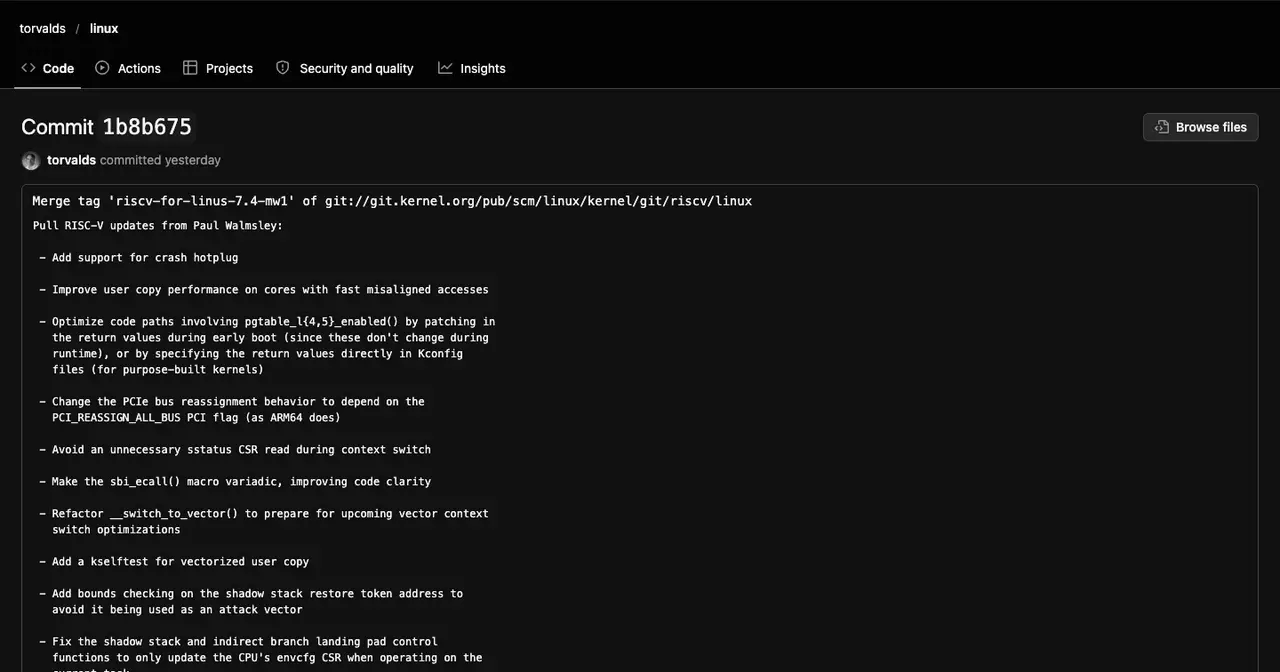
The Linux 7.4 merge window opened after Linux 7.3 came out on 18 October, and on 29 October 2026 Linus Torvalds merged the RISC-V pull sent by Paul Walmsley, one of the architecture’s maintainers. It’s 28 commits with no big headline, but several of them will reach anyone running a distribution kernel on RISC-V hardware.
Faster user copies, now on generic kernels too
The most practical change comes from Andy Chiu. When the kernel copies data between its own memory and a program’s (a user copy), it runs code that aligns accesses in software for processors that handle misaligned accesses badly. On cores that handle them well, skipping that code raises copy bandwidth by up to 11.4%, according to the figure in the patch.
That optimisation already existed, but only at build time: it depended on HAVE_EFFICIENT_UNALIGNED_ACCESS, which in turn requires marking the kernel as non-portable. No distribution does that, because its kernel has to boot on very different boards. In Linux 7.4 the decision moves to boot time: the kernel measures how fast misaligned accesses are and, if the CPU is quick, turns the jump into the alignment code into a no-op through a static key. So the same generic Debian, Fedora or Ubuntu kernel gets the speed-up wherever the hardware allows it.
Crash hotplug and other kernel plumbing
- Crash hotplug (Rui Qi): when CPUs or memory are added or removed on a running system, the header that describes the machine to the crash-capture kernel (
elfcorehdr) is kept up to date. Without it, a crash after a topology change produced avmcorethat didn’t match the real machine. The implementation follows the x86 model. - Page tables (Jisheng Zhang):
pgtable_l4_enabled()andpgtable_l5_enabled(), which say whether 4 or 5 paging levels are in use, return a value that never changes after boot. They are now patched in during early boot, or fixed in Kconfig for purpose-built kernels, with the newRISCV_ISA_SV48andRISCV_ISA_SV57options. - Context switch: an unnecessary read of the
sstatusregister is avoided, and the vector unit’s context switch is reorganised ahead of future optimisations. There’s also a newkselftestfor vectorised user copy. - PCIe: bus reassignment now depends on the
PCI_REASSIGN_ALL_BUSflag, as on ARM64. RISCV_ALTERNATIVEis no longer optional, now that XIP kernel support has been removed.
New extensions visible to user space
Andrew Jones adds the “B” extension to hwcap and hwprobe, the interface programs use to ask what the CPU can do. “B” bundles the bit-manipulation extensions Zba, Zbb and Zbs, and the kernel makes sure that when it reports B, all three are set as well. Programs can now query it directly, as they already could with F, D, C or V.
Zic64b, which says cache blocks are 64 bytes, can now be declared and reported too. It has been added to the device trees of the SpacemiT K1 and K3 and the Sophgo SG2044 SoCs. Device tree validation also now requires the block size of cache-management operations to be specified (the Zicbom, Zicbop and Zicboz extensions).
Security and errata
Samuel Holland hardens the shadow stack, the protected stack that defends against attacks rewriting return addresses: the restore token’s address is now bounds-checked before use so it can’t become an attack vector. Another fix makes the shadow stack and indirect-branch landing pad control functions write the envcfg register only when they act on the current task.
On MIPS-designed RISC-V hardware, errata can now be applied during early boot, and on the P8700 the kernel stops using the WFI instruction, which is buggy on that chip, and uses mips.pause instead.
KVM
The RISC-V virtualisation changes for 7.4 arrive through the KVM tree: support for the KVM_PRE_FAULT_MEMORY ioctl, a fix for inter-processor interrupt delivery when vcpu_id values are out of order, and the option to expose the Zicclsm, Ziccamoa, Ziccif and Za64rs extensions to guests.
When it lands
If the usual two-week merge window holds, the first release candidate, Linux 7.4-rc1, will be out this Sunday, 1 November, with the final release around late December or early January. Kernel versions and dates are on the Linux page. To see how a distribution makes use of specific architecture extensions, have a look at using custom RISC-V instructions on Ubuntu. And for comparison with an earlier cycle, here’s what Linux 7.1 brought.
Sources: merge “riscv-for-linus-7.4-mw1” and merge “kvm-riscv-7.4-1” in Linus Torvalds’ tree; commits by Andy Chiu (“riscv: optmize ucopy for has_fast_unaligned_accesses”), Rui Qi (“riscv: crash: Add crash hotplug support”) and Andrew Jones (“riscv: Add B to hwcap and hwprobe”).