The Linux Mint team published its October monthly news on 31 October 2026, signed by Clem Lefebvre, and this one is packed with in-house apps. The two that stand out cover jobs every Linux user does daily: Superlight, for keeping an eye on the system, and Velocitty, a new terminal. They come with Unfold, an archive manager. It wasn’t a complete surprise: the September news had already mentioned “three other projects” getting their finishing touches, and promised to talk about Superlight, Unfold and Velocitty the following month.
Keep in mind the caveat the blog repeats every month: what’s shown is a preview, still being worked on, and planned for the next version of Linux Mint.
Superlight, the system monitor
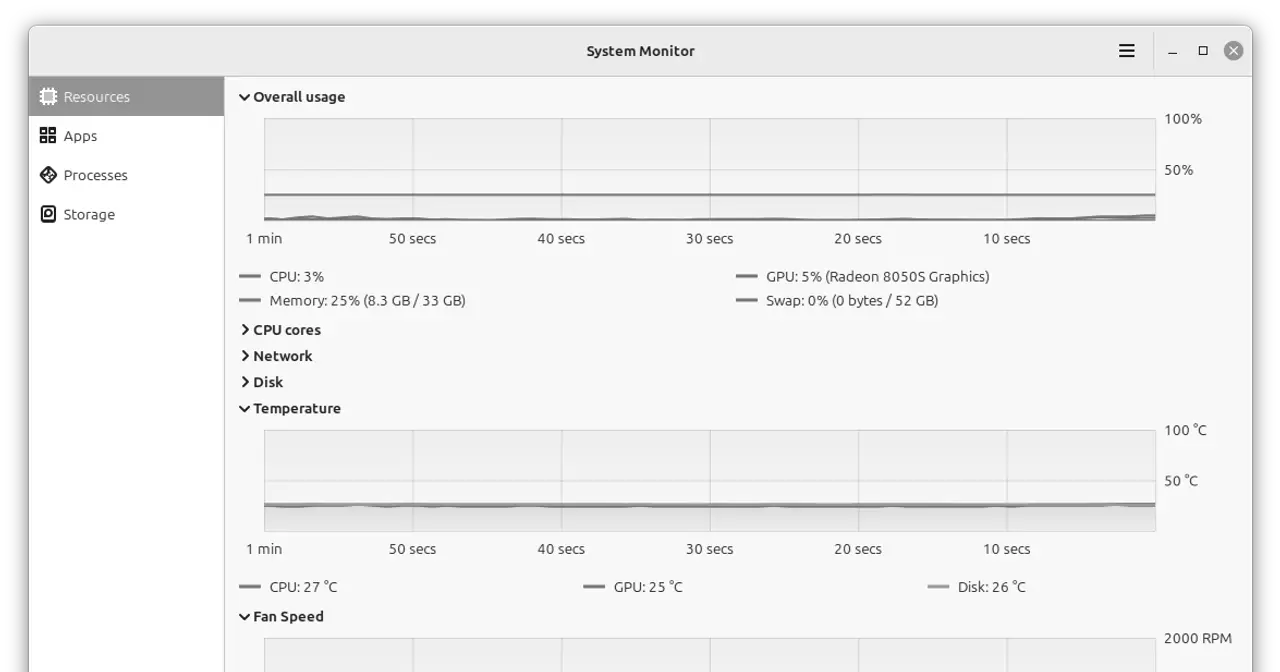
Superlight shows what’s going on inside the machine. Its main page draws graphs for CPU and RAM, plus swap, GPU, network, disk I/O, temperature and fan speed. In the screenshot published with the announcement, the window is simply titled “System Monitor” and the content is split into four sections: resources, apps, processes and storage.
- Apps: what’s running and how much of the system each application is using, grouped per app.
- Processes: the same data for every running process. There’s a wide choice of columns that you can sort and reorder, and Superlight remembers the layout.
- Battery: on laptops, the battery’s status and details, with a history of charge level and power in and out.
- Storage: how much disk space is used and by what. It starts with an overall breakdown; click on files to browse which folders take up the most space, and there are dedicated views for Steam games and Flatpak apps.
The blog’s pitch is that it makes it easy to see what’s eating your resources. The disk part is the welcome bit: on Linux that question usually ends in du, ncdu or a separate app.
Velocitty, a terminal whose tabs warn you
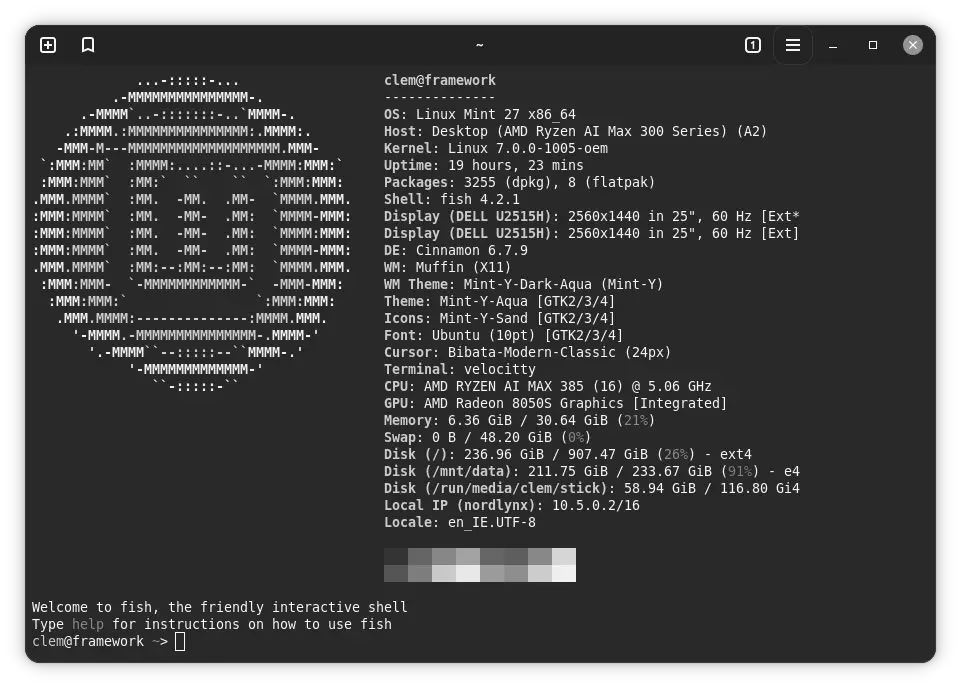
Velocitty is the other big one. The team describes it as really simple to use but packed with features:
- A tab overview, like the one in Ghostty and Ptyxis.
- Theming with colour palettes.
- Firefox-style tabs: reorder them within a window, move them to another terminal window or detach one into a new window.
- Configurable shell and startup command. The blog’s example runs
fishand launchesfastfetchon startup. - Shortened paths: a preference turns
/var/lib/dpkg/infointoinfoin the tab name and…/lib/dpkg/infoin the prompt. - Tab colours that reflect what’s happening: red for superuser (root,
sudo,pkexecand so on), blue for remote sessions (ssh,sftp…) and a lighter shade while a process is running. - Custom tabs with a name, a colour, a command to run and an option to open automatically when Velocitty starts. A bookmark icon lists them all, so your usual projects and SSH sessions are one click away.
Anyone who looks after servers will appreciate the colours most: spotting at a glance which tab has sudo or which one is logged into a remote box saves the odd scare.
Unfold and the rest of October’s news
Unfold is a small archive manager designed to be as simple as possible: view, create and extract archives. Under the hood it uses 7zip and 7zip-RAR, and supports every encryption format they handle, including password-protected archives.
October’s post covers more ground:
- A Sleep Modes page in the System Administration tool that makes it easy to enable and set up hibernation, which Ubuntu had removed from the available sleep modes and was therefore usually missing in Mint. Hybrid Sleep and Suspend-then-Hibernate (which hibernates when the battery goes critical) are added too.
- A preview pane in Nemo, the file manager, toggled with F7. It handles audio, pictures and video and shows media details, such as when a photo was taken and with which camera.
- Xenity, a fork of Zenity 3.44 (GTK3) with the same features, look and syntax, now in the Mint 22.x and LMDE 7 repositories. Cinnamon spices that used Zenity have been moved to Xenity.
What the blog doesn’t say is what Superlight, Velocitty and Unfold are built with, or whether they’ll replace the apps Mint currently ships for those tasks. There are no public repositories under those names yet on Linux Mint’s GitHub, where the code for the rest of its tools lives. We’ll have to wait for the beta to try them.
Linux Mint 27 “Adrien”, due at Christmas
All of this is heading for Linux Mint 27 “Adrien”, which the September news says is scheduled for Christmas and will be based on Ubuntu 26.04. It will ship in at least three editions: Cinnamon, Xfce and MATE.
It’s also the first release the team has spent a full year developing, after moving from a six-month schedule to a yearly one. Clem Lefebvre writes that the extra time lets them take on projects that would previously have been too large or ambitious, and that in more than 20 years of working on Linux Mint they can’t remember this many changes in a single release. Clocks, the alarm app shown in September as part of the Clockenstein project, belongs to the same batch.
The numbering changes as well. The release number now stands for the upcoming year, and point releases are gone: after 27 comes 28, then 29, with no “.1” or “.2”. And since the girls’ names have run through the whole alphabet, from “Ada” to the “Zena” of Linux Mint 22.3, the new series switches to boys’ names. Current versions and support dates are on the Linux Mint page.
Sources: Monthly News – October 2026 and Monthly News – September 2026, official Linux Mint blog.