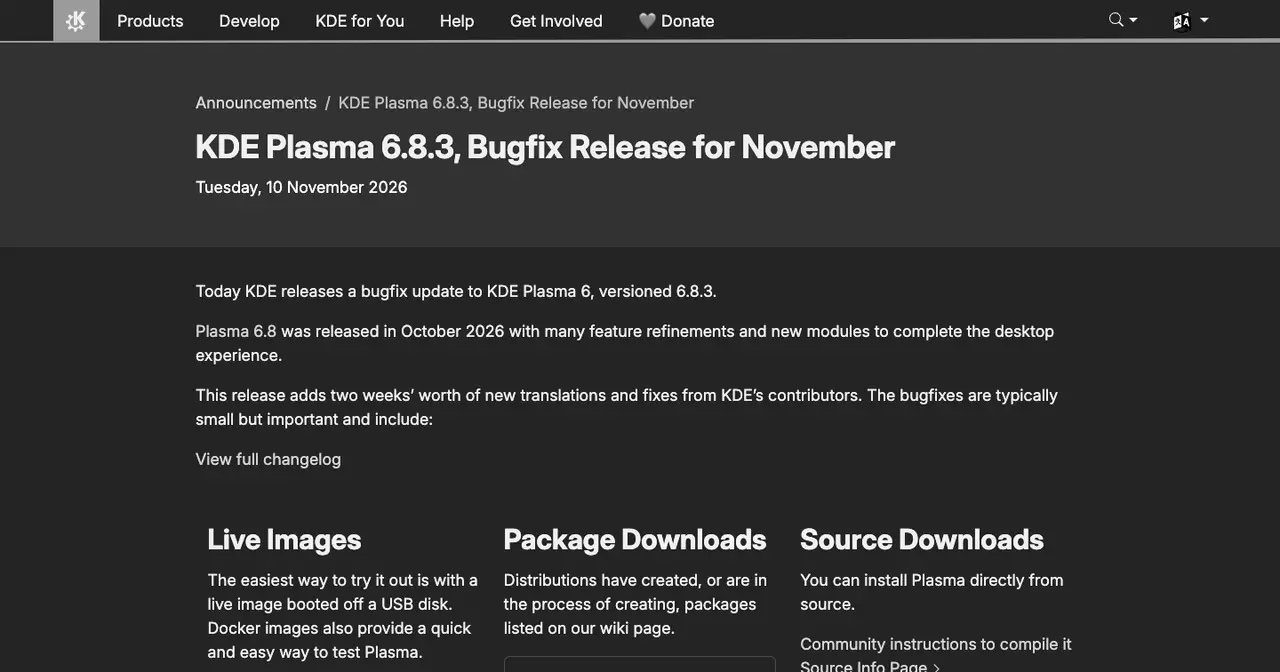
Two pieces of the Linux desktop were updated almost at once. On 9 November came Mesa 26.3, the free graphics stack that handles OpenGL and Vulkan for nearly every GPU that works on Linux. The next day, 10 November, KDE released Plasma 6.8.3, the third batch of fixes for the series that arrived in October. Neither will change your desktop overnight, but both will land on your machine in the coming weeks, especially if you run a rolling distro.
Mesa 26.3: what it brings
As with every .0 release, Mesa warns that 26.3.0 is a “development release” and that anyone who cares about stability should stay on 26.2 or wait for 26.3.1. Rolling distributions usually package the .0; fixed-release ones wait for a point release.
On the API side it implements OpenGL 4.6, Vulkan 1.4 and OpenCL 3.1, although the version each application sees depends on the driver. What’s new, by vendor:
- AMD (RADV and radeonsi). The headline is
VK_AMD_anti_lagin RADV, the Vulkan extension AMD uses to cut the delay between pressing a key or moving the mouse and seeing it on screen. RADV didn’t have it until now. RADV also gainsVK_KHR_video_encode_feedback2for video encoding andVK_KHR_performance_queryon GFX12, the RDNA 4 generation. On the OpenGL side, radeonsi addsEGL_NV_context_priority_realtime. - Arm Mali (Panfrost and PanVK). Support for Mali G68, G715 and G615 GPUs, and Vulkan 1.3 on older Mali chips (PanVK’s v6 and v7 generations) with a good handful of maintenance extensions. That is what many Arm boards and laptops carry.
- Imagination PowerVR (pvr). The driver with the most new items on the list: about twenty extensions and features, including global queue priority, transform feedback and support for the BXM-4-64 GPU.
- NVIDIA (NVK). The free Vulkan driver for NVIDIA adds
VK_KHR_maintenance11, internally synchronised queues andVK_KHR_device_address_commands. - Apple Silicon (Honeykrisp). The Vulkan driver from the Asahi Linux project adds
VK_KHR_maintenance10, untyped pointers andVK_KHR_shader_fma. - Raspberry Pi (v3dv). Three more extensions for the Vulkan driver of the Pi 4 and Pi 5, including
VK_KHR_map_memory2. Relevant to Raspberry Pi OS. - Intel (iris). Semaphores and external semaphores in OpenCL, and floating-point atomics (
cl_ext_float_atomics) in iris, llvmpipe and zink. - Vivante (etnaviv). OpenGL ES 3.0 on HALTI5 GPUs, common on embedded boards.
On top of that, the notes list 182 bug fixes, from hangs in specific games to shader compiler problems.
Plasma 6.8.3: fixes in KWin and display handling
Plasma 6.8 came out on 14 October with a major change: it no longer offers an X11 session and sticks to Wayland (apps that still need X11 keep working through XWayland). Bugfix releases polish what slipped through, and 6.8.3 brings two weeks of translations and fixes. The most noticeable ones are in KWin, the compositor:
- Multi-GPU machines. Fixes to the workarounds KWin uses with NVIDIA and amdgpu when the image is composed on one card and output through another, which is typical of hybrid laptops.
- Screens and scaling. A better default scale on handhelds and tablets, avoiding interlaced modes when a progressive one exists, correct detection of the adjacent monitor in the zoom effect’s “push” mode, and a fix to the linear segment of the sRGB curve.
- Suspend. KWin now ignores signals that wake the screens once the system is going to sleep, and a new thread detects when the compositor hangs.
- Triple buffering. Frame scheduling is fixed when triple buffering is combined with Wayland’s commit timing. In Plasma 6.8 triple buffering is on by default for NVIDIA.
Elsewhere on the desktop:
- Powerdevil fixes screens staying dimmed after losing brightness control, and the charge limit hint now only shows for the system battery, not for a mouse or headphones.
- Plasma Workspace fixes a crash when opening launchers with keyboard shortcuts, a cloned panel that didn’t know which screen it was on, and the wallpaper resetting when the screen size changed a lot.
- Union, the new style engine Plasma 6.8 lets you try as “Breeze (Union)”, gets around twenty fixes to control sizing and alignment.
- KRDP, the built-in remote desktop server, disables the RDSTLS security mode.
- The calendar no longer turns years 0 to 99 into 1900-1999, and the digital clock zero-pads hours when 24-hour time is forced.
When you’ll get it
- KDE neon gets Plasma 6.8.3 almost immediately, since that is what it exists for.
- Arch and openSUSE Tumbleweed usually have both releases in their repositories within days.
- Fedora and Fedora Kinoite update Plasma within the same release, and Mesa once its maintainers consider it stable.
- LTS releases such as Ubuntu, Debian or Linux Mint don’t jump Mesa or Plasma versions mid-cycle, apart from Ubuntu’s hardware enablement stacks.
To check what you have: glxinfo -B | grep "OpenGL version" (from the mesa-utils package) or vulkaninfo --summary for Mesa, and plasmashell --version for Plasma.
If you want to see how Plasma has changed this year, in June we went through what’s new in Plasma 6.7.
Sources: Mesa 26.3.0 release notes (also on docs.mesa3d.org once published), KDE Plasma 6.8.3 announcement, full changelog from 6.8.2 to 6.8.3 and Plasma 6.8 announcement.