Two people, one full-time researcher and one intern, plus an automated scanner driven by language models. That is what Microsoft’s FORGE lab used to go through part of the Linux kernel between late May and mid-June. On 11 November its researcher, Cen Zhang, published the results: 59 public reports sent to maintainers, 33 CVEs assigned, eight of them with an exploit that gets local root, and fixes for 38 reports already merged into mainline.
The most striking number is none of those. It is this one: the scanner took about two weeks to find the bugs, and turning them into accepted patches has taken five months and more than four person-months of work. We checked the CVEs one by one, the commits in Linus Torvalds’ tree and the age of each bug. The lab’s numbers add up.
From 26,502 findings to 59 reports
FORGE did not scan the whole kernel. It picked security-sensitive subsystems that do not depend on specific hardware, such as networking, filesystems and security modules, so every bug could be reproduced in a QEMU virtual machine without the device at hand. The tool, which Microsoft calls MDASH internally, ran on two servers (64 cores and 256 GB, and 32 cores and 128 GB).
This is how the funnel looked:
| Stage | Cases | What happened |
|---|---|---|
| Scanning | 26,502 | Raw findings in about two weeks |
| Filtering | 11,769 | Low-confidence claims dropped by fast screening agents |
| Reproduction | 621 | An agent writes a proof of concept that triggers the bug in QEMU |
| Reports | 59 | An expert reviews root cause, duplicates and the patch |
The lab also lists the models it used. For reading code, mostly Sonnet 4.6 (71.1% of tokens), GPT-5.4 (20.1%) and GPT-5.5 (7.1%). For writing proofs of concept, GPT-5.5 (77.3%), Opus 4.6 (13.2%) and GPT-5.5-cyber (9.4%).
Of the 621 cases with a proof of concept, only about one in ten became a new report. 266 (42.8%) shared a root cause with another case and were fixed by the same patch, 163 (26.2%) were dropped for low security impact and 133 (21.4%) had already been reported or fixed. The arithmetic holds: 266 + 163 + 133 + 59 = 621. That last group is down to timing. The first public report did not go out until 27 June, more than five weeks after scanning began, and in the meantime other researchers, many also using AI tools, were finding the same bugs.
What we checked
The eight CVEs with root exploits that FORGE lists, plus the one for the oldest bug, exist on cve.org, were issued by the kernel’s own CNA and point to the files the lab mentions. For each one we pulled from the record the commit that introduced the bug and the one that fixes it, looked both up in Torvalds’ repository and confirmed that the fix is already in mainline:
| CVE | File | What breaks | CVSS |
|---|---|---|---|
| CVE-2026-64554 | net/ipv6/netfilter.c | Use-after-free when fragmenting bridged IPv6 | 8.8 |
| CVE-2026-64563 | lib/rhashtable.c | Use-after-free when resuming a hash table walk | 7.8 |
| CVE-2026-64580 | net/ipv6/xfrm6_policy.c | Reference count dropped twice in IPsec | 7.8 |
| CVE-2026-74561 | net/ipv4/nexthop.c | IPv6 route list walked without its lock | 8.8 |
| CVE-2026-74562 | net/ipv4/nexthop.c | Same thing, in another function | 8.8 |
| CVE-2026-89789 | drivers/net/gtp.c | Tables freed while packets still reach the GTP tunnel | 7.8 |
| CVE-2026-98222 | security/keys/…/encrypted.c | 16-bit length overflow in encrypted keys | — |
| CVE-2026-98364 | net/xfrm/xfrm_policy.c | Network device used without a reference in IPsec | 7.8 |
The CVSS score is the one in each CVE record; the encrypted keys one has none yet. FORGE says 24 of its 33 CVEs are rated High or above. We could not check that fully, because the complete list is not published.
The authorship checks out too. The patches are signed by Cen Zhang and Xiang Mei of Microsoft and carry the tag Reported-by: [email protected]. The kernel mailing list link in FORGE’s post groups exactly 59 distinct messages, the same 59 reports it announces.
Bugs with years behind them
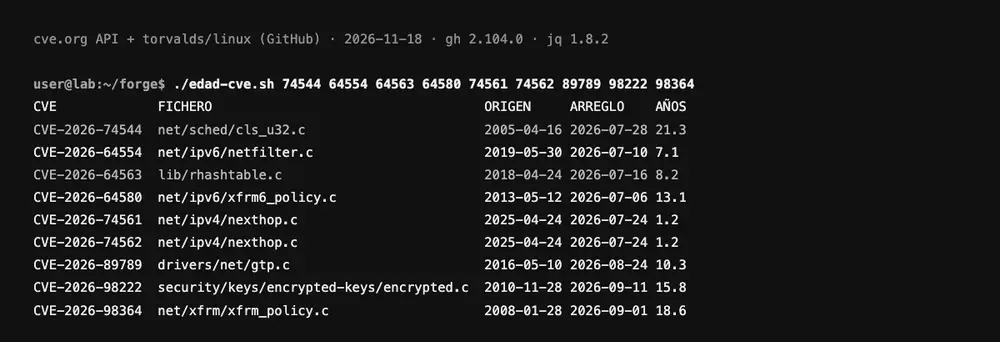
FORGE says the 59 bugs had been in the kernel for 8.1 years on average when it reported them. We cannot repeat that average without the full list, but we can measure the nine CVEs above. Their average is even higher, about 10.8 years, which makes sense: they are the most serious ones and tend to sit in old networking code.
The oldest is in cls_u32, the tc traffic classifier. CVE-2026-74544 lists commit 1da177e4c3f4 as the origin, which is the very first commit in the Linux git repository, from 16 April 2005. That is why FORGE says “at least 21 years”: the bug predates the kernel’s move to git, and nobody can say by how much.
nexthop is the opposite case. Both CVEs in that table come from the same April 2025 commit, which added a lock to protect the IPv6 route list. The patch forgot to take it in three places that also walk the list. A concurrency fix that leaves concurrency holes: exactly the kind of bug a human reviewer skims past and a tool that reads every access to the list catches without getting tired.
CVE-2026-64563: one forgotten line in rhashtable
The example FORGE explains in detail is the most instructive. rhashtable is the resizable hash table shared by dozens of kernel subsystems. Many of them store live objects in it, such as sockets, and walk it when a program asks to list them. If the list is long, the walk happens in batches: it stops, sends a reply and resumes where it left off. To do that the iterator keeps a pointer to the last visited entry, iter->p.
In 2018, a commit meant to make those walks more stable stopped clearing iter->p on pause and moved that reset into the resume function. That function has two paths. If the old table is still there, it checks whether the saved entry still exists. If the table was resized in the meantime and the old one is gone, it switches to the new one and starts over from the beginning, but does not clear the pointer. On the next step, the kernel follows iter->p->next on an object that may already have been freed.
The fix, merged in July, is literally one line:
 		iter->walker.tbl = rht_dereference_rcu(ht->tbl, ht);
 		iter->slot = 0;
 		iter->skip = 0;
+		iter->p = NULL;
 		return -EAGAIN;
It took eight years to spot because three things have to happen in the same walk: it must be paused and resumed, the table must be resized during the pause, and the saved entry must also be freed in that window. But in one of the table’s users, netlink socket diagnostics, the pause is controlled by the program itself, which decides when to read the next reply. Any unprivileged user can pause, trigger the resize, close the socket and refill that memory with whatever they like. The result is a 64-bit write into kernel memory which, combined with other known techniques, gives root. It also works on Android with SELinux enforcing and needs neither user namespaces nor unusual build options.
FORGE credits Yuan Tan of NebuSec, who found the same bug independently and wrote the exploits for Linux and Android. The fix commit carries both Reported-by lines.
Fixing costs more than finding
The kernel usually expects a security report to come with a working patch, and that is where AI helped least. FORGE’s agents wrote a first draft, but understanding the subsystem, validating the change and answering maintainers remained human work. Of the 38 merged reports, half went in on the first submission and the rest needed one to four revisions. From the first public patch to a Linux release with the fix took a median of 41 days, and up to 108 in the worst case.
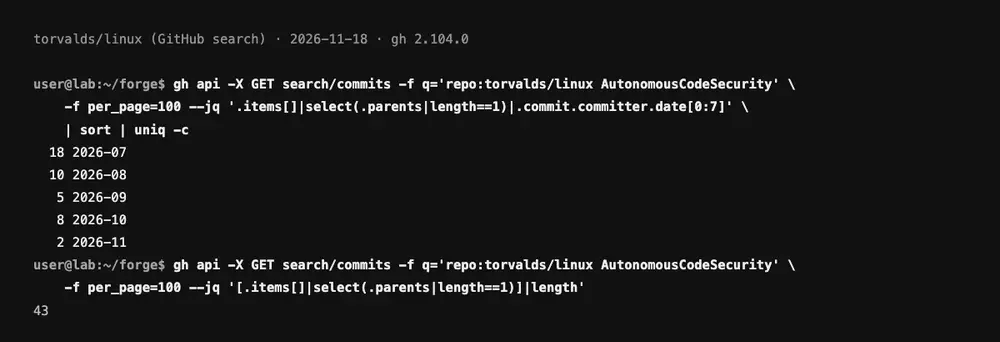
In Torvalds’ tree we counted 43 commits (excluding merges) carrying the Microsoft scanner tag: 18 in July, 10 in August, 5 in September, 8 in October and 2 so far in November. That is a few more than the 38 reports because some bugs needed two patches and other developers also cited the tag in related fixes. Only 14 of those 43 commits carry a Cc: stable line, which asks for the fix to be copied to stable releases; the rest reach stable through Sasha Levin’s automatic selection or not at all. Besides networking, there are fixes in ksmbd, NTFS3, io_uring, userfaultfd, AppArmor, NFS and mac80211.
This fits what we wrote yesterday about the flood of AI-found fixes landing on the kernel’s C code: finding bugs has become cheap and reviewing them is still expensive. Zhang says as much in his conclusion: both bug hunters and maintainers can be overwhelmed by the volume of real findings, so the focus should be on the serious ones. He adds a line worth remembering: more tokens may yield more bugs, but not a secure system.
Which versions ship the fixes
According to the CVE records as of 18 November, anyone on Linux 7.3 (any 7.3.x) has all nine bugs in the table fixed. On the 7.2 branch, from 7.2.8 onwards. The long-term branches lag behind:
| Branch | Current version | Bugs from the table with no published fix |
|---|---|---|
| 6.18 LTS | 6.18.64 | CVE-2026-98364 |
| 6.12 LTS | 6.12.118 | CVE-2026-98364 |
| 6.6 LTS | 6.6.162 | CVE-2026-98364 and CVE-2026-98222 |
| 6.1 LTS | 6.1.192 | CVE-2026-98364 and CVE-2026-98222 |
| 5.15 and 5.10 | 5.15.225 and 5.10.274 | Also CVE-2026-64580 and CVE-2026-74544 |
The IPsec bug CVE-2026-98364 dates from 2008 and, according to its record, is only fixed in 7.2.8 and 7.3. The two nexthop bugs do not affect branches older than 6.16 because the code is from 2025.
To see which kernel you run, use uname -r. Be careful comparing that number with the table: Debian, Ubuntu, RHEL, SUSE and the rest do not follow kernel.org versions but backport fixes into their own kernels. The reliable check is to look the CVE up in your distribution’s security tracker (security-tracker.debian.org, ubuntu.com/security/cves or access.redhat.com/security/cve) and install kernel updates when they ship. On servers that run third-party code or let unprivileged users in, such as shared hosting, multi-user systems or container hosts, do it as soon as they are available.
Our take
This is one of the most honest reports we have read about AI applied to bug hunting. It gives the full funnel, says which models it used and in what proportion, shows how many findings it threw away and why, and admits that people are the bottleneck. That is worth more than another headline about thousands of vulnerabilities found by a machine.
It also leaves a less comfortable reading. If two people with a scanner can pull 59 real bugs out of a small part of the kernel in three months, anyone with the same means can do it, including people who will not tell the maintainers. The 133 cases already reported by others show that a lot of people are looking in the same places at once. For sysadmins the practical consequence is simple: the gap between “a fix lands in the kernel” and “there is an exploit” is shrinking, and regular kernel updates stop being good practice and become an obligation. For kernel maintainers the problem is a different one, and more tokens will not solve it.
How we tested this
We did not run the exploits, which FORGE does not publish. What we did, on 18 November, was check its numbers against primary sources from a Mac with gh 2.104.0 and jq 1.8.2:
- The records of the nine CVEs from the cve.org API (
https://cveawg.mitre.org/api/cve/CVE-2026-NNNNN), which give the file, the introducing commit, the fix commits, the fixed versions and the CVSS score. - Each commit’s date and whether the fix is in mainline, with
gh api repos/torvalds/linux/commits/<sha>andgh api repos/torvalds/linux/compare/<sha>...master(aheadmeans the commit is already inmaster). - The count of commits with the Microsoft tag, using GitHub’s commit search and leaving out merges.
- The 59 message IDs in the lore.kernel.org query linked from FORGE’s post, counted one by one.
This is the script behind the age table; it needs curl, jq and a logged-in gh:
#!/bin/sh
printf '%-15s %-41s %-10s %-10s %s\n' CVE FICHERO ORIGEN ARREGLO AÑOS
for n in "$@"; do
  curl -s -o cve.json "https://cveawg.mitre.org/api/cve/CVE-2026-$n"
  f=$(jq -r '.containers.cna.affected[0].programFiles[0]' cve.json)
  intro=$(jq -r '.containers.cna.affected[0].versions[0].version' cve.json)
  fix=$(jq -r '.containers.cna.references[-1].url' cve.json | sed 's#.*/##')
  d1=$(gh api repos/torvalds/linux/commits/$intro --jq .commit.committer.date | cut -c1-10)
  d2=$(gh api repos/torvalds/linux/commits/$fix --jq .commit.committer.date | cut -c1-10)
  st=$(gh api repos/torvalds/linux/compare/$fix...master --jq .status)
  [ "$st" = ahead ] || [ "$st" = identical ] || d2="NO-MAINLINE"
  y=$(python3 -c "from datetime import date as D;a=D.fromisoformat('$d1');b=D.fromisoformat('${d2%%N*}' or '$d1');print(f'{(b-a).days/365.25:.1f}')" 2>/dev/null)
  printf '%-15s %-41s %-10s %-10s %s\n' "CVE-2026-$n" "$f" "$d1" "$d2" "$y"
done
Run it as ./edad-cve.sh 74544 64554 64563 64580 74561 74562 89789 98222 98364 (the column headers are in Spanish: file, origin, fix, years). Ages are counted from the commit that introduced the bug to the fix commit, not to the report date, so they come out slightly higher than FORGE’s measure.
Sources: Lessons from 59 Linux Kernel Bug Reports, Cen Zhang, Microsoft FORGE Lab (11 Nov 2026); records for CVE-2026-64554, CVE-2026-64563, CVE-2026-64580, CVE-2026-74544, CVE-2026-74561, CVE-2026-74562, CVE-2026-89789, CVE-2026-98222 and CVE-2026-98364 on cve.org; commits 8173f7e2ce67 (rhashtable), aef96eead286 (cls_u32) and 5d240a8936f6 (origin of the rhashtable bug, 2018) in Linus Torvalds’ tree; current releases on kernel.org. Accessed 18 Nov 2026.