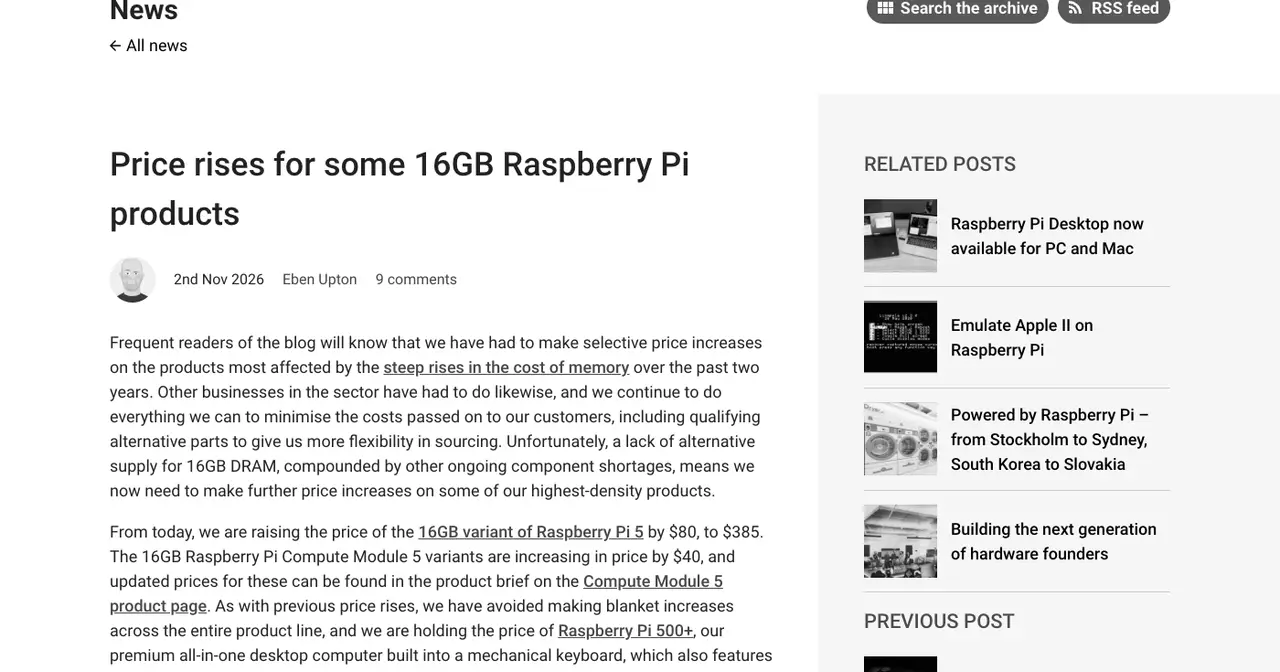
Since 2 November 2026 the 16GB Raspberry Pi 5 has cost $385, $80 more than it did last week. Eben Upton, Raspberry Pi’s CEO, announced it on the official blog, and the new price applied from the day the post went up. The Compute Module 5 16GB variants go up by $40 in the same round; the post doesn’t list their new prices, which are in the product brief on the Compute Module 5 page.
One 16GB product escapes: the Raspberry Pi 500+, the all-in-one computer built into a mechanical keyboard, keeps its current price.
Why now
It’s memory again. According to Upton, DRAM costs have climbed steeply for two years, and the company has tried to soften the blow by qualifying alternative parts so it has more room to manoeuvre when sourcing. That hasn’t worked for 16GB chips: there’s no alternative supply, and other component shortages are still dragging on. Hence a targeted increase on the highest-density products rather than across the whole range.
Earlier posts filled in the background. In October 2025 Raspberry Pi said memory cost roughly 120% more than a year before, because demand for HBM for AI was competing for fab capacity with the commodity LPDDR its boards use. By April 2026 the figure was far worse: the LPDDR4 in the Raspberry Pi 4 and 5 had become seven times more expensive in a year.
Four rises in eleven months
The 16GB model launched at $120. Here’s how its price has moved since, according to the official announcements:
| Date | Change | 16GB Pi 5 price |
|---|---|---|
| 1 December 2025 | +$25 | $145 |
| 2 February 2026 | +$60 | $205 |
| 1 April 2026 | +$100 | $305 |
| 2 November 2026 | +$80 | $385 |
That’s more than three times its price a year ago. The rest of the line-up hasn’t been spared either. October 2025 brought small rises for 4GB and 8GB Compute Modules; December added the first board increases alongside a new $45 1GB Pi 5; February hit everything with 2GB or more; April hit 4GB-and-up boards, the Pi 500 and 500+ (and introduced a 3GB Pi 4 at $83.75); and on 1 October 2026 the 2GB boards went to $67.50 (Pi 4) and $77.50 (Pi 5).
If you’re about to buy one
Raspberry Pi’s advice is simple: don’t pay for memory you won’t use. The company suggests lower-density variants or earlier models, plus memory optimisation in your own software. For a new project that leaves a few options within the range:
- The 1GB Pi 5 is still $45, its launch price from December 2025; Raspberry Pi has kept it out of every round since.
- The 2GB Pi 5 has been $77.50 since October.
- If you genuinely need 16GB on a desktop machine, the Raspberry Pi 500+ is unchanged this time.
- Classic models (Zero, Pi 3 and the like) use LPDDR2, of which Raspberry Pi holds years of stock, and the company doesn’t expect to raise their prices.
To squeeze more out of the RAM you have, Raspberry Pi points to its official magazine’s memory tips for Raspberry Pi OS and to its forums. If you already run a board, keep the system up to date as well: in June the distribution moved to Linux 6.18 LTS.
The post also carries a warning. Some sellers are exploiting the shortage to resell at inflated prices or pass off products that aren’t what they claim to be. Buy from Raspberry Pi Approved Resellers, who stick to the official prices.
Upton repeats what the company has said from the start: the memory squeeze is temporary, and the increases will be rolled back once costs fall. For now, the top-end Pi 5 costs over three times what it did a year ago.
Sources: “Price rises for some 16GB Raspberry Pi products” (2 Nov 2026); “Price increases for 2GB Raspberry Pi 4 and Raspberry Pi 5” (1 Oct 2026); “A new 3GB Raspberry Pi 4 for $83.75, and more memory-driven price increases” (1 Apr 2026); “More memory-driven price rises” (2 Feb 2026); “1GB Raspberry Pi 5 now available at $45, and memory-driven price rises” (1 Dec 2025); “$5–$10 price increases for some 4GB and 8GB products” (1 Oct 2025), all on raspberrypi.com.