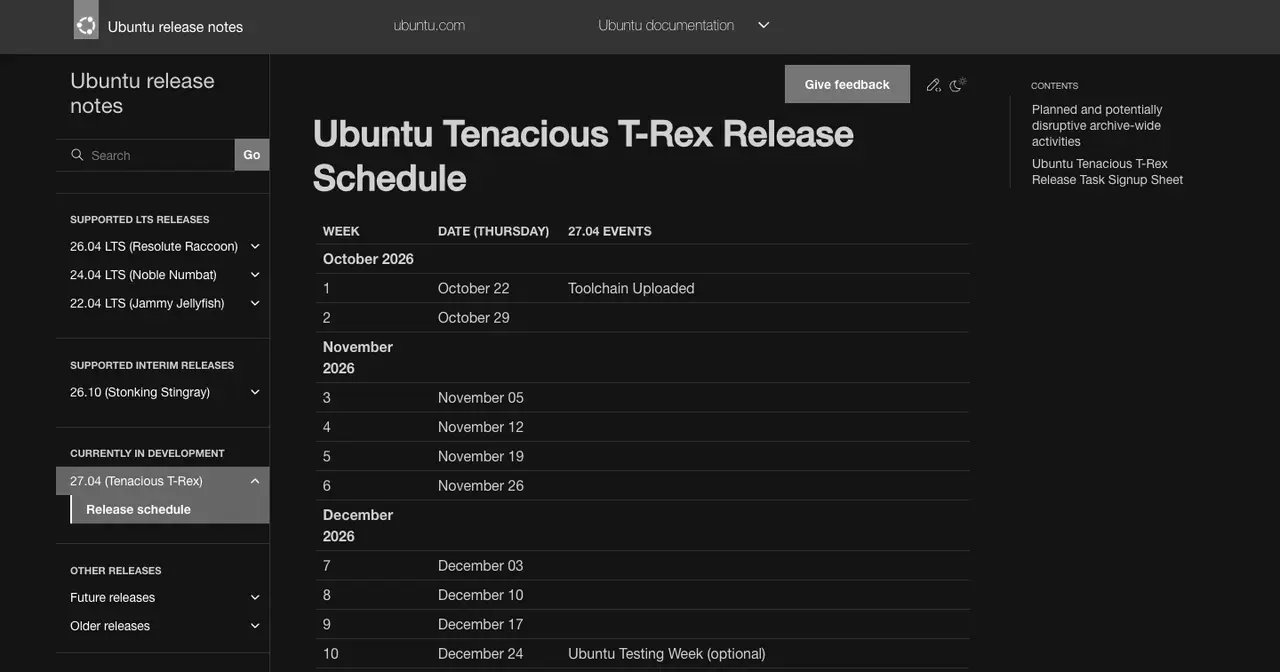
Two weeks after Ubuntu 26.10 “Stonking Stingray” shipped (15 October), the next cycle is already under way. Graham Inggs, on behalf of the Ubuntu release team, announced on the ubuntu-devel list on 30 October 2026 that Ubuntu 27.04 “Tenacious T-Rex” is open for development. It’s an interim release, without long-term support, and it’s due on 22 April 2027.
What “open for development” means
The tenacious archive now accepts uploads, and the toolchain went in during the week of 22 October. The email gives the usual warning for these first weeks: expect a flood of builds and automated tests (autopkgtests) and the delays that come with them. Developers are asked to test their uploads in a tenacious chroot first and to help fix whatever breaks.
Auto-sync from Debian will be switched on “soon”. When that happens, a large batch of new packages will arrive from Debian unstable, which is the base of every Ubuntu release.
There’s also a housekeeping change: the -changes mailing list, which carried every upload to the archive, is replaced by an Atom feed of upload changelogs on Launchpad.
The Ubuntu 27.04 schedule
These are the official dates, all Thursdays except one:
| Date | Milestone |
|---|---|
| 22 Oct 2026 | Toolchain uploaded |
| 24 Dec 2026 | Testing week (optional) |
| 25 Feb 2027 | Feature Freeze and Debian Import Freeze |
| 4 Mar 2027 | Testing week (optional) |
| 18 Mar 2027 | User Interface Freeze |
| 25 Mar 2027 | Documentation String Freeze and Kernel Feature Freeze |
| 29 Mar 2027 (Monday) | Beta Freeze and Hardware Enablement Freeze |
| 1 Apr 2027 | Beta |
| 8 Apr 2027 | Kernel Freeze |
| 15 Apr 2027 | Final Freeze and Release Candidate |
| 22 Apr 2027 | Final release |
The old alphas and the first beta are gone: for a few cycles now they’ve been replaced by those ad hoc testing weeks. Like every interim release, 27.04 gets nine months of support, so if you want long-term stability you should stay on Ubuntu 26.04 LTS. Our guide to Ubuntu LTS releases explains how the two kinds of release work.
What we already know it will bring
The 27.04 release notes page is still an empty template, but Canonical has given away a few things over the year.
ntpd-rs for time sync. On 26 March the Trifecta Tech Foundation announced that Ubuntu would adopt ntpd-rs, its NTP implementation written in Rust, as the default time synchronisation client and server. In June Canonical became a Gold sponsor of the foundation and spelled out the plan: test ntpd-rs in Ubuntu 26.10 and make it the default in 27.04. It’s another step in the push to replace core system utilities with memory-safe Rust rewrites, as already happened with sudo-rs.
AI features on the desktop. In April, Jon Seager, Canonical’s VP of Engineering, posted on Discourse how the company wants to bring AI into Ubuntu over the following year. The centrepiece is inference snaps, which give access to local models tuned for your hardware under the same confinement as any other snap, along with a preference for local inference by default. When people asked for a global switch to turn it all off, Seager replied that he didn’t think there would be one; control would go through each snap’s permissions. There’s no final list yet of what will land in 27.04.
What is settled is the date: barring surprises, the tenacious dinosaur arrives on 22 April 2027. In the meantime, the Ubuntu page has the supported releases and their end-of-life dates.
Sources: “Tenacious T-Rex is now open for development”, ubuntu-devel list; Ubuntu 27.04 release schedule and release notes, from Canonical; Canonical becomes Gold Sponsor of Trifecta Tech Foundation, Ubuntu blog; Ubuntu to adopt ntpd-rs as the default time synchronization client and server, Trifecta Tech Foundation; The future of AI in Ubuntu, Ubuntu Discourse.