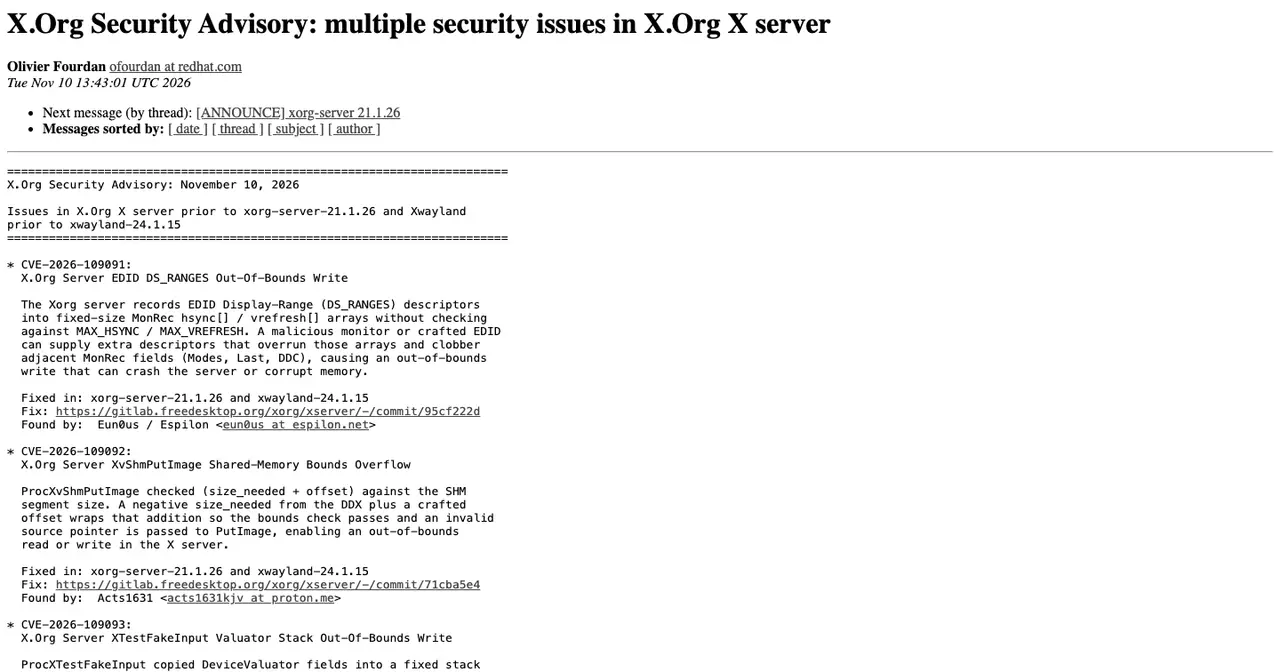
On 10 November 2026 the X.Org project published an advisory covering eight vulnerabilities in the X server, and released the versions that fix them the same day: xorg-server 21.1.26 and Xwayland 24.1.15. All of them are memory-handling bugs: reads or writes past the end of a buffer and integer overflows that slip through size checks. At best the server crashes. At worst its memory gets corrupted.
No need to panic, but you should update. This affects anyone on a classic X11 session and also anyone on Wayland, because almost every Wayland desktop starts Xwayland for the applications that still speak X11.
The eight flaws, one by one
The advisory is signed by Olivier Fourdan of Red Hat, and half of the bugs live in Xv, X’s video extension:
| CVE | Where | What happens |
|---|---|---|
| CVE-2026-109091 | Monitor EDID parsing (Xorg only) | A malicious monitor or crafted EDID with extra range descriptors writes past a fixed-size array |
| CVE-2026-109092 | Xv, XvShmPutImage |
A negative size plus a crafted offset make the shared-memory check accept an invalid address |
| CVE-2026-109093 | XTest, XTestFakeInput |
Device values are copied into a stack array before checking that they fit |
| CVE-2026-109904 | XRes, QueryClientIds |
A multiplication without an overflow check lets a short request through; 32-bit servers only |
| CVE-2026-109094 | XRes, QueryResourceBytes |
The same issue in the byte-swapping path; also 32-bit only |
| CVE-2026-109095 | glamor, Xv image size | NV12/YV12 image sizes computed with 32-bit integers wrap around and let through requests that lack the data they claim |
| CVE-2026-109096 | Xv, XvPutImage |
A negative image size fools the length check |
| CVE-2026-109903 | Xv, XvQueryImageAttributes |
With that same negative size, the server replies with a bogus value instead of an error |
They were found by Eun0us (Espilon), Acts1631 and Tristan Madani (Talence Security). Each one has its own commit in the freedesktop.org repository, linked from the advisory.
Xwayland 24.1.15 carries seven of the eight. The EDID bug doesn’t apply, because that code belongs to the Xorg server that drives the display directly, and in a Wayland session that is the compositor’s job.
Who is really exposed?
The advisory doesn’t mention active exploitation or public proofs of concept. Almost all of these bugs require being able to connect to the X server, in other words being an X11 client in that session. On a personal laptop that means malicious software is already running as your user. So the risk goes up in three situations:
- The Xorg server runs as root. Most distributions now start it as the session user thanks to logind. Even so, older setups, display managers without that support and systems with the setuid wrapper still exist, and there a memory bug in the server is worth a lot more.
- Shared machines or remote desktop servers (Xvnc, XRDP, thin clients) where several users or clients reach the same X server.
- The EDID bug changes the vector: a monitor or adapter with a crafted EDID triggers it. It needs physical access, but no logged-in session.
Debian, for instance, rates the flaws in its Xwayland package as low importance, because Xwayland should never run as root.
Which distributions already have it
As of late on 10 November:
- Arch Linux already ships
xorg-server21.1.26 andxorg-xwayland24.1.15 in the extra repository. - Fedora has Xwayland 24.1.15 on its way for Fedora 43, 44 and 45, pending promotion to stable in Bodhi.
- Debian still shows bookworm, trixie and sid as vulnerable in its security tracker, with bug #1153675 open.
- Ubuntu and Red Hat had not yet published advisories. When they do, look for a USN and an RHSA.
The identifiers had not yet shown up on cve.org or in the NVD either, which is normal in the first hours after an advisory.
Watch the version numbers: Debian, Ubuntu and RHEL don’t move to 21.1.26. They apply the patches on top of their own version (Debian 13 ships 21.1.16 with its own revisions). To know whether your package carries the fix, look for the CVEs in its changelog, not at the version number.
How to check your system
First, what kind of session you have and which X servers are running:
echo $XDG_SESSION_TYPE          # x11 or wayland
ps -o user=,comm= -C Xorg,Xwayland
If the user column for Xorg says root, this advisory matters to you more than to most.
Then, the installed version for your distribution:
# Debian and Ubuntu
dpkg -l xserver-xorg-core xwayland
apt changelog xserver-xorg-core | grep -m3 CVE-2026-1090

# Fedora, RHEL and derivatives
rpm -q xorg-x11-server-Xorg xorg-x11-server-Xwayland
rpm -q --changelog xorg-x11-server-Xwayland | grep -m3 CVE-2026-1090

# Arch
pacman -Q xorg-server xorg-xwayland
If you build it yourself or use a distribution that tracks upstream releases, Xorg -version and Xwayland -version should report 21.1.26 and 24.1.15 or later.
What to do
- Update as soon as your distribution ships the packages:
sudo apt update && sudo apt upgrade,sudo dnf upgrade --refreshorsudo pacman -Syu. - Log out of the graphical session or reboot. The running X server is still the old one until it restarts, and the same goes for Xwayland, which the compositor starts when you log in.
- Don’t open the X server to anyone who shouldn’t reach it. Check that
xhosthas no open rules (xhostwith no arguments should say access control is enabled) and that it isn’t listening on TCP. On remote desktops, limit who can connect. - Until the patch lands, on shared machines prefer Wayland sessions: they still use Xwayland, but the compositor doesn’t hand it direct control of the display and it doesn’t run as root.
It isn’t the first time this autumn: on 16 October X.Org published another batch of flaws, that time in the libX11 and libXi client libraries. That’s to be expected from a forty-year-old codebase that more and more tools are now combing through. If you’re wondering whether it’s worth leaving X11 behind, we cover that in X11 vs Wayland. And if you run OpenBSD, its X server comes from Xenocara and fixes arrive as errata, as happened with OpenBSD 7.8 errata 037.
Sources: X.Org security advisory of 10 Nov 2026, release announcements for xorg-server 21.1.26 and Xwayland 24.1.15, X.Org security page, Debian security tracker, Arch packages xorg-server and xorg-xwayland, and Fedora updates in Bodhi.