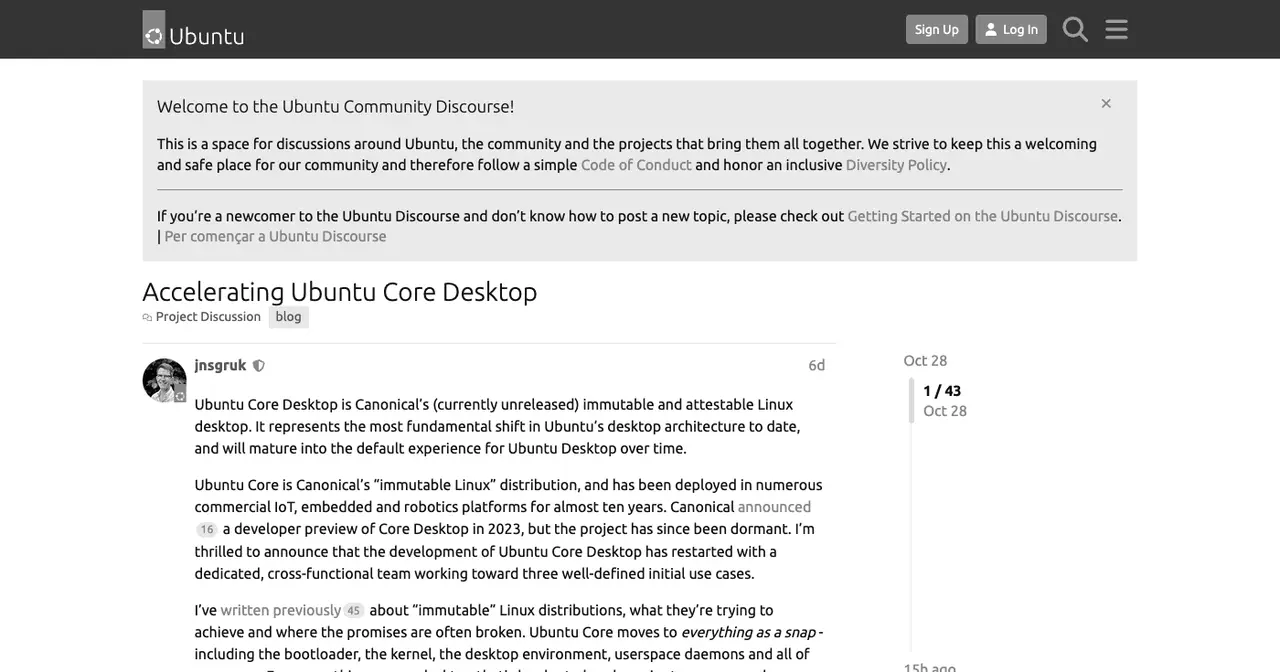
Ubuntu Core Desktop had been sitting still for almost three years, and now it’s moving again. On 28 October 2026, Jon Seager, who leads Ubuntu engineering at Canonical, posted «Accelerating Ubuntu Core Desktop» on the Ubuntu Discourse. The project has restarted with a dedicated, cross-functional team, and the long-term goal is for it to become the default Ubuntu desktop experience. The timing lines up with the start of the Ubuntu 27.04 «Tenacious T-Rex» cycle, which is when the team plans to rework the architecture.
What Ubuntu Core Desktop is
Ubuntu Core is Canonical’s immutable flavour of Ubuntu, used for nearly ten years in IoT, embedded and robotics products. On Core everything is a snap: the bootloader, the kernel, the gadget (which describes the specific hardware), the base with the minimal system, services and apps. You don’t modify the system by hand; it updates transactionally, and if a kernel or base update goes wrong the device boots back into the previous version.
Core Desktop brings that model to the desktop. Seager describes it as a system that’s «harder to break, easier to recover» and that gives users more control over what data their apps can reach, because every app has to be a strictly confined snap.
From the 2023 pitch to the long pause
Canonical floated the idea on its blog in May 2023 («Ubuntu Core as an immutable Linux Desktop base») and showed a developer preview that year that people could build and install. Plenty of users expected it alongside Ubuntu 24.04 LTS, but on 30 January 2024 Tim Holmes-Mitra, then heading Ubuntu Desktop, replied on Discourse that it wouldn’t be released by 24.04 and that no date could be given until several user-experience problems were solved. After that, as Seager puts it, the project went «dormant».
The new post is candid about that preview: it «fell short». The main problem was architectural. It swapped the core22 base for a monolithic alternative base that bundled GDM, the GNOME desktop and, in early builds, even Firefox. That got a working proof of concept out quickly, but it broke the whole idea of components that update independently.
What’s changing
The new team has spent the past few weeks reviving the old preview: re-establishing pipelines, rebuilding images and making «a big dent» in rebasing it on core26, the Ubuntu 26.04 base. For the cycle that’s just starting, the roadmap is to:
- Break the desktop into modules with clear interfaces, so the display manager, desktop environment, multimedia servers, networking and the rest stay implementation-agnostic.
- Define the snap interfaces a full desktop environment needs.
- Validate the design against three initial use cases: a browser-centric machine (Firefox and Chromium are already snaps), a developer workstation built on LXD and Canonical Workshop, and a gaming machine with the Steam snap, where Mesa, drivers and Proton versions could be swapped without destabilising the system.
- Have continuous testing and daily image builds ready «over the coming weeks».
Canonical is also partnering again with enioka Haute Couture and the KDE Neon Core team on a KDE variant. Seager is clear that Core Desktop shouldn’t be tied to GNOME and that Ubuntu flavours must still be able to offer choice.
The hard parts: apps and permissions
The big hurdle is that on Ubuntu Core every app must be a strictly confined snap. There are over 11,000 snaps in the Snap Store and most work on Core, but classic snaps such as Visual Studio Code, and Canonical Workshop for now, don’t. Workshop is being moved to strict confinement; for everything else, the preferred plan is to run graphical apps inside a Workshop and show their windows on the host desktop, much like WSLg on Windows. The same goes for apt, nix or Flatpak users: the advice will be to use containers or VMs rather than the host.
The other piece is permissions prompting, which coordinates the kernel, AppArmor and snapd to ask the user at runtime, phone-style, without apps having to be modified. It already covers the camera, microphone and home directory access, and Seager sees it as key to Core Desktop’s success.
Will it ship with Ubuntu 27.04?
Not as an installable, daily-driver release, at least based on what’s been announced. The post talks about using «the coming release cycle» to modularise the desktop and about daily images within weeks, but it doesn’t commit to a final release or a date. Test images during 27.04 development are the realistic expectation; 27.04 itself is due on 22 April 2027. Seager also stresses that the current, deb-based Ubuntu Desktop isn’t going away.
Compared with Silverblue and Aeon
The obvious comparisons are Fedora Silverblue and openSUSE Aeon, which we covered in our explainer on immutable Linux.
- Fedora Silverblue ships the OS as a whole image managed by rpm-ostree, with apps from Flatpak and development in Toolbx containers. You can layer RPMs on top of the image when you have to.
- openSUSE Aeon, still at release-candidate stage, uses MicroOS technology: transactional updates applied on reboot, Flatpak from Flathub and Distrobox with Tumbleweed containers.
- Ubuntu Core Desktop bets on snaps for everything, kernel and boot included, plus a modular desktop. Seager pitches that as the key difference: parts evolve independently without rebuilding the entire image whenever something changes.
Next to classic Ubuntu the gap is bigger. There, apt is still in charge and snaps sit alongside debs; on Core Desktop you won’t be able to install a package into the base system, and anything that isn’t a snap goes into a container. You get a system that heals itself; you pay in compatibility, which is exactly what the team now has to prove.
Sources: «Accelerating Ubuntu Core Desktop», Jon Seager on the Ubuntu Discourse (28 Oct 2026); «Ubuntu Core as an immutable Linux Desktop base», Ubuntu blog (31 May 2023); Tim Holmes-Mitra’s reply about 24.04 (30 Jan 2024); Ubuntu 27.04 release schedule; Aeon Desktop website.