Linus Torvalds has lost his temper in public again, and this time artificial intelligence is in the middle of it. On 24 November Ted Ts’o, the ext4 maintainer and one of the most senior kernel developers, sent him the file system’s pull for Linux 7.4-rc5. It was huge for this point in the cycle: 94 commits and more than 41,000 new lines, mostly KUnit tests, plus a long list of fixes that, by Ts’o’s own account, were mostly AI-generated.
Torvalds merged it, but replied with the kind of email we had not seen from him in a while. Capital letters included.
What Ted Ts’o sent
The pull was titled “updates for 7.4-rc5”, and Ts’o’s own message explained where the volume came from: most of the new lines are KUnit tests, which he said make it “safer to validate AI generated patches”. Then came three small performance improvements and what he called “a huge number of bug fixes, most of which were AI generated”.
The fixes are not trivial. There are fast commit fixes to avoid losing fsync’ed data after a journal flush, fixes for EXT4_IOC_MIGRATE losing data on long ranges, for stale data returned after a failed zeroout, for out-of-bounds accesses on corrupted file systems, several use-after-frees and a buffer/folio lock inversion deadlock. They are exactly the kind of rare, hard-to-reproduce bugs that AI tools are surfacing all over the kernel.
Torvalds’ reply
Torvalds answered at 20:36 UTC, with the pull already merged. First, he did not think it was appropriate at this stage: the tests should have stayed in a separate branch and this “huge” update should have waited for the next merge window. He called the idea that anything that is a fix belongs in an -rc “bogus” and warned that next time he would simply ignore it.
Then, in capital letters, a line that sums up his position: stop thinking that you, “or AI”, never add bugs when you fix something.
The underlying argument is the most interesting part of the email. If AI finds subtle bugs that went unnoticed for years, its fixes by definition touch subtle, rarely exercised code. And that makes the fixes themselves possibly buggy. That is why there are release candidates and several weeks of calming things down, he reminds Ts’o. He also says he was about to unpull it and chose to give a warning instead.
The paragraph that gives this story its headline is the last one: Ts’o should tell his AI companion to get its act together and do any new development and test cases “ON A SEPARATE DAMN BRANCH”, so it can be merged during the merge window. Torvalds admits that means Ts’o has to handle the resulting conflicts while running the tests, and he prefers that to adding “tens of thousands” of lines in the middle of a release.
The apology and the end of the thread
Ts’o replied a few hours later with a “yeah, sorry”. He explained that the tests were on a separate branch and that he had deliberately put them at the end of the pull so that, if Torvalds objected, they could easily be dropped and only the earlier commits sent. He offered a revised pull, keeping the tests for the merge window.
Torvalds closed the thread at 03:07 UTC on the 25th: he still objects, but it is merged and not worth undoing. The test infrastructure caused conflicts that he resolved himself, and he asked Ts’o to check the merge, because the resolutions looked correct but he had not run any of those tests. The merge is commit 4dce97c6c265 in Torvalds’ tree.
What was in the pull, by our count
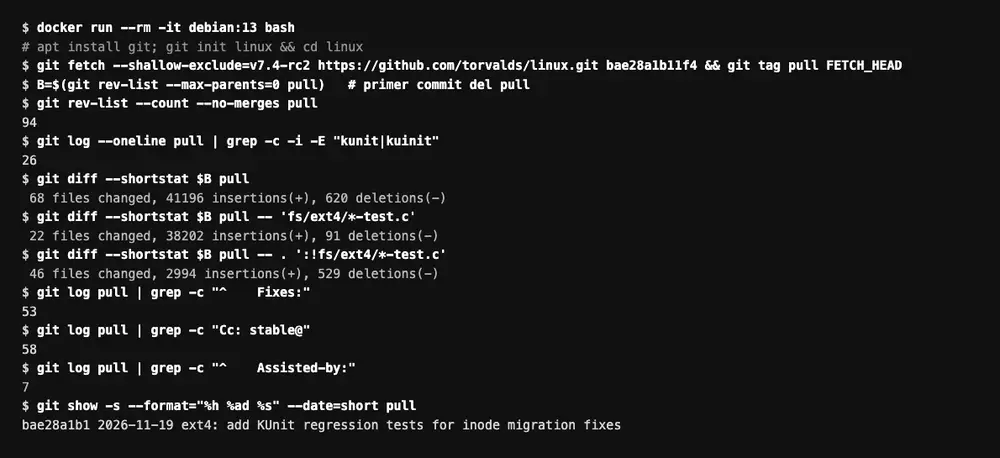
We fetched only the pull’s commits, starting from the v7.4-rc2 tag that Ts’o’s branch is based on, and counted them. The numbers match the one Torvalds quotes (“41197 insertions”):
| What | Count |
|---|---|
| Commits (no merges) | 94 |
| Lines added in total | 41,196 |
In fs/ext4/*-test.c test files |
38,202 (22 files) |
| In the rest of the code | 2,994 (46 files) |
Fixes: lines |
53 |
Cc: stable@ lines |
58 |
Commits with Assisted-by: |
7 |
93% of what was added is tests. The ext4 code itself changes by about 3,000 lines, still a lot for an rc5 but nowhere near 41,000. That is Ts’o’s point: the tests are not built in a normal kernel (KUnit is optional) and they exist to check the fixes. And it is exactly what Torvalds rejects: code that is hardly ever built can still break things, and it arrives with conflicts that have to be resolved by hand.
Another striking detail: Ts’o says most of the fixes were made with AI, yet only seven commits carry an Assisted-by: tag. That is not an oversight. As we reported when covering the AGENTS.md Btrfs wants, Linux 7.4-rc1 removed that tag from the documentation because barely one in ten AI-assisted commits used it. The current guide, generated-content.rst, asks for transparency but no longer prescribes a tag.
Why this is more than a rant
The rule Torvalds invokes is written down in Documentation/process/2.Process.rst: after the two-week merge window, -rc1 marks the end of new features, and for the following six to ten weeks only patches that fix problems should go in. What has changed is how much AI can fit into “fixing problems”. If a tool finds fifty bugs at once, they are all fixes, and they all arrive together.
We are seeing it across the kernel. Microsoft needed five months of human work to turn two weeks of AI scanning into 59 useful reports, Lorenzo Stoakes stopped reviewing memory management patches because of the volume, and the Rust versus C debate in Linux 7.4 showed the same bottleneck: finding bugs is now cheap and reviewing them is still expensive. Torvalds is adding another brake, the calendar. AI fixes can wait for the merge window like everything else.
It is not the first time this year he has raised his voice over how code arrives; in June he forced sched_ext to be reorganized. But this time the target is one of the kernel’s most senior maintainers, and the message is also aimed at everyone using AI to hunt for bugs.
Does it affect me if I use ext4?
Barely, and probably for the better. The 58 Cc: stable@ lines mean many of these fixes will reach the stable branches, including 7.3, which looks set to be the 2026 LTS. If your distribution follows those branches, you will get them with regular kernel updates. The KUnit tests are not built in distribution kernels, so they add nothing to your system.
What remains is a warning that applies to anyone maintaining code: a fix is new code too, and if nobody else has tested it for a few weeks, it may fix one bug and introduce another.
How we tested this
On 25 November, in a debian:13 (arm64) container with the distribution’s git. We fetched from Torvalds’ tree only the commits between v7.4-rc2 and the tip of the ext4 branch (bae28a1b11f4), without cloning the whole kernel, and measured the pull with git diff --shortstat from the branch’s first commit, separating test files from the rest:
docker run --rm -it debian:13 bash
apt update && apt install -y git ca-certificates
git init linux && cd linux
git fetch --shallow-exclude=v7.4-rc2 https://github.com/torvalds/linux.git \
    bae28a1b11f422d0214654800d9425e042295c71
git tag pull FETCH_HEAD
B=$(git rev-list --max-parents=0 pull)
git rev-list --count --no-merges pull
git diff --shortstat $B pull -- 'fs/ext4/*-test.c'
git diff --shortstat $B pull -- . ':!fs/ext4/*-test.c'
git log pull | grep -c "^    Assisted-by:"
That first commit, a small readdir fix for 32-bit kernels, is left out of the diff, which is why we get 41,196 lines rather than 41,197. We read the emails on lore.kernel.org and the merge message on GitHub.
Sources
- [GIT PULL] updates for 7.4-rc5, Ted Ts’o, linux-ext4 (24 Nov 2026).
- Linus Torvalds’ reply (24 Nov 2026, 20:36 UTC).
- Ted Ts’o’s apology and Torvalds’ closing message (25 Nov 2026).
- Merge tag ‘ext4_for_linus-7.4-rc5’, Linus Torvalds’ tree.
- Documentation/process/2.Process.rst and generated-content.rst, kernel documentation.
Accessed 25 Nov 2026.